
As Amazon Associates, we earn from qualifying purchases. This means we may receive a small commission at no extra cost to you if you click through and make a purchase.
Content creators, solo documentary filmmakers, and commercial field crews working beyond municipal power grids face an essential technical decision: selecting the right balance of watt-hour capacity, peak surge capability, and portable mass. In evaluating modern jackery lifepo4 battery power stations, production teams must balance battery chemistry longevity against the physical realities of mobile transport. A run-and-gun videographer hiking to remote vantage points requires a featherweight power hub to maintain drone batteries, wireless microphones, and camera packs. In contrast, an on-location digital imaging technician (DIT) managing high-brightness client monitors, fast raid storage arrays, and color-calibrated editing workstations requires deep continuous kilowatt-level output that can run uninterrupted across extended production days.
According to the brand’s published specifications, this hardware lineup is organized into three distinct tiers defined by storage scale, inverter performance, and structural mobility. The ultralight foundation includes the 292Wh portable series, delivered either as an independent power pack or packaged with folding solar equipment for self-sustaining remote work. The mid-tier production category centers on the 1000-series chassis, expanding capacity past the kilowatt-hour threshold while introducing high-speed app-managed recharging and multi-port simultaneous output. At the top of the range, heavy-duty mobile stations span from 3,584Wh to 5,040Wh, featuring luggage-style rolling hardware, modular pack expansion, and split-phase 120V/240V dual-voltage capabilities. Reviewing this jackery lifepo4 comparison demonstrates how moving up through the product tiers affects your field flexibility, charge turnaround, and continuous production output.
This guide by the numbers
9.8/10
Best rated model
Our highest score in this line-up
5
Models on file
Models in this guide that have a stored product record
1
Brand involved
Distinct brand names on the product records used here
Prices and specifications come from the stored Amazon listing data for the products in this article. Scores are out of 10, based on listed specifications and buyer feedback.
Jackery Portable Power Stations Lineup at a Glance
| Model | Capacity | Continuous Output | Weight |
|---|---|---|---|
| Jackery Explorer 300 Portable Power Station,292Wh | 292Wh | 300W (600W Surge) | 7.1 lbs |
| Jackery Explorer 1000 v2 Portable Power | 1,070Wh | 1,500W (3,000W Surge) | 23.8 lbs |
| Jackery HomePower 3600 Plus Power Station | 3,584Wh | 3,600W (7,200W Parallel) | 77.2 lbs |
| Jackery Solar Generator 5000 Plus Portable | 5,040Wh | 7,200W (14,400W Surge) | The listing does not specify |
| Jackery Solar Generator 300 and 40W | 292Wh | 300W (600W Surge) | 7.5 lbs |
The Models in Detail
01
Jackery Explorer 300 Portable Power Station,292Wh

Jackery Explorer 300 Portable Power Station,292Wh
Best for: Solo creators needing ultra-lightweight power
Pros
- 1-pound ultralight chassis
- 4,000-cycle LiFePO4 chemistry
- 100W USB-C Power Delivery
Cons
- 300W continuous output limit
- Solar panel not included
The Jackery Explorer 300 Portable Power Station,292Wh is an ultra-compact field station designed for mobile creators who prioritize transportability over high-output draw. With an item weight listed at 7.1 pounds (and 7.5 pounds noted in key descriptive specifications), this power station is built with a molded, integrated top handle that makes it effortless to pack alongside camera bags, audio cases, or field camping equipment. The unit relies on upgraded LiFePO4 battery chemistry engineered to provide over 4,000 full charge cycles before the internal cells drop to 70% capacity, yielding more than 11 years of regular operational service life. It features two 120V AC output receptacles, a fast 100W USB-C Power Delivery port, two USB-A ports, and a 120W DC car accessory port, enabling concurrent power delivery to up to six external devices.
Recharging options for this compact model accommodate fast-paced field schedules. When connected to a standard AC wall supply via the included adapter, the unit recharges in approximately 4 hours, and it also includes a car charger cable for vehicle top-ups between remote shoot locations. When paired with solar input, the internal battery reaches an 80% charge level in roughly 2.8 hours using a 100W panel, or in 7.5 hours when connected to a 40W panel. With a continuous AC output rating of 300W and a 600W peak surge threshold, it operates efficiently as a mobile charging hub for mirrorless camera batteries, video gimbals, field monitors, sound gear, and portable laptops. The dedicated 100W USB-C connection allows editors to fast-charge laptops directly without connecting a bulky AC wall transformer.
This entry-level unit is best suited for solo content creators, run-and-gun documentarians, and travel vloggers who need reliable battery replenishment without hauling heavy equipment cases. However, its 300W continuous output rating presents clear boundaries. It cannot run high-draw continuous LED studio lights, heavy production heat guns, coffee makers, or editing workstations undergoing heavy GPU rendering loads. Creators operating full-day location shoots with professional lighting grids or high-draw video equipment will find that the Explorer 300 must give way to the larger capacity and 1,500W output of the Explorer 1000 v2.
02
Jackery Explorer 1000 v2 Portable Power
Jackery Explorer 1000 v2 Portable Power
Best for: Mobile video crews running multi-device sets
Pros
- 1,500W output with 3,000W surge
- 1-hour emergency app recharging
- Compact folding handle design
Cons
- 1-hour charging requires app activation
- 120V output only
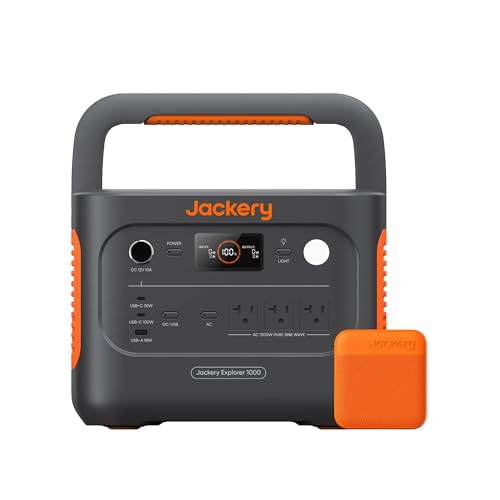
Stepping up into mid-tier field production capabilities, the Jackery Explorer 1000 v2 Portable Power functions as a versatile mobile workstation power hub. Housing a 1,070Wh LiFePO4 battery pack, this unit outputs 1,500W of continuous pure sine wave AC power alongside a 3,000W surge peak capacity. It delivers this output across three standard pure sine wave AC outlets, two USB-C ports (supporting up to 100W USB Power Delivery), a USB-A port, a DC car port, and an integrated LED light bar for working in dark staging areas. The physical design weighs 23.8 pounds and features a foldable carrying handle that stores flat, allowing the station to stack cleanly inside production vans and vehicle trunks alongside lighting grip and camera flight cases.
Recharging speed is a standout technical feature of this model, managed through the integrated ChargeShield 2.0 system and the brand’s mobile application. While standard AC wall charging defaults to 1.7 hours to safeguard battery longevity, creators facing quick turnaround times can activate the emergency charging mode via the app to accomplish a 0 to 100% full recharge in just 60 minutes. For studio spaces, quiet podcast sets, or overnight tent charging, users can switch the unit into a subdued 30 dB quiet mode. As detailed in our comprehensive battery generator jackery guide, finding the optimal balance between battery weight and continuous output is critical for field reliability. The Explorer 1000 v2 provides an LFP battery lifespan rated for over 4,000 cycles to 70% capacity, representing more than 10 years of usable operational life.
This model is the ideal choice for independent production crews, commercial video operators, and mobile filmmakers who need to run continuous 300W to 600W LED studio lights, client video monitors, DIT laptops, and high-volume drone battery banks simultaneously. It easily handles small field refrigerators, electric kettles, and portable projectors. However, while 1,500W handles individual high-demand appliances, it remains limited to standard 120V circuits and cannot power multiple heavy industrial tools or full-scale basecamp distribution setups. Production units that require dual-voltage 240V lines or expanded multi-kilowatt-hour storage must step up to the HomePower 3600 Plus.
03
Jackery HomePower 3600 Plus Power Station
Jackery HomePower 3600 Plus Power Station
Best for: Location basecamps needing expandable capacity
Pros
- 3,584Wh capacity with 3,600W output
- 6,000-cycle ceramic membrane cells
- Luggage-style wheels and handle
Cons
- Heavy 77.2-pound frame
- 240V requires parallel units
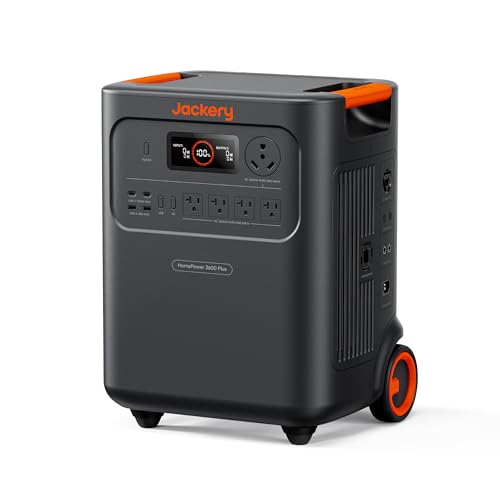
For dedicated production basecamps, mobile broadcast vehicles, and heavy-duty remote video villages, the Jackery HomePower 3600 Plus Power Station delivers stationary-grade electrical output in a transportable form. Carrying the model designation JHP-3600A, this unit is engineered around a 3,584Wh LiFePO4 battery bank paired with a 3,600W continuous AC inverter. When paired in parallel with a second matching unit, it can deliver up to 7,200W of output and unlock 120V/240V dual-voltage functionality. The battery core utilizes automotive-grade Cell-to-Body (CTB) engineering and high-temperature resistant ceramic membrane battery cells tested up to 302 °F to resist thermal runaway, while maintaining reliable discharge capabilities in extreme conditions down to -4 °F. The system provides an exceptional durability rating of 6,000 charge cycles across a 10-year lifespan.
The unit incorporates four flexible recharging pathways to fit diverse production environments. Using hybrid AC plus DC charging, the internal 3,584Wh battery replenishes completely from 0 to 100% in 2 hours. It can also be recharged via AC power alone in 2.5 hours, dedicated solar arrays in 4 hours, or a standard fuel-powered generator in 2.5 hours. Designed with plug-and-play ease for pairing with manual transfer switches, the station also allows modular capacity scaling. Users can attach auxiliary battery units to expand a single station to 21kWh, or link multiple units to achieve up to 43kWh of total capacity. Consulting our jackery expansion battery pack walkthrough outlines how these external modules integrate into permanent and mobile workflows.
Despite its large capacity, the manufacturer states the unit is 34% smaller and 29.3% lighter than comparable 3.6kWh LFP units on the market. Weighing 77.2 pounds with dimensions of 15.2 x 12.2 x 19.3 inches, it features luggage-style rolling wheels and an extendable telescopic handle for moving across soundstages and flat outdoor sets. This station is tailored for commercial production coordinators, live-stream broadcast technicians, and basecamp managers running heavy HMI or cinema LED arrays, craft services appliances, and multi-user editing stations. However, its 77-pound weight makes it unsuitable for solo creators without transport vehicles. Furthermore, if your production demands native 240V high-amperage output from a single unit without external parallel linking, the Solar Generator 5000 Plus is the necessary alternative.
04
Jackery Solar Generator 5000 Plus Portable
Best for: Off-grid documentary filmmakers and backpackers
Pros
- Includes 40W Air solar panel
- Lightweight 7.5-pound generator
- 100W USB-C PD charging
Cons
- 300W inverter limit
- Units may ship separately
Jackery Solar Generator 5000 Plus Portable
Best for: Heavy production villages needing 240V power
Pros
- Native 120V/240V 7,200W output
- Expandable up to 60kWh
- 4,000W fast solar input
Cons
- Dimensions and weight not specified
- Solar panels sold separately
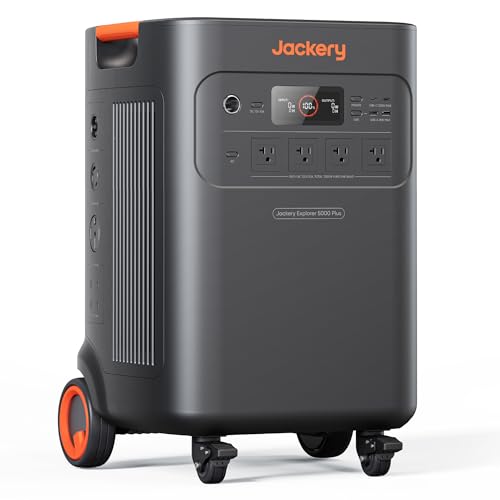
Representing the apex of power capacity and output performance in this lineup, the Jackery Solar Generator 5000 Plus Portable is built for commercial location operations and complete basecamp electrical management. It features a massive 5,040Wh LiFePO4 battery paired with an inverter that delivers 7,200W of continuous rated output and a 14,400W peak surge engine power maximum. Unlike smaller models that require parallel adapters, this station natively provides dual-voltage 120V and 240V outputs directly from its main interface. It operates with a 30A current rating and can interface directly with an optional 60A Smart Transfer Switch to supply up to 12 individual 120V branch circuits or 6 dedicated 240V circuits during extended off-grid shoots or municipal power blackouts.
The internal battery management architecture relies on ChargeShield 2.0 technology and high-grade LiFePO4 cells rated for up to 11 years of continuous daily use. Recharging this expansive 5,040Wh capacity is exceptionally fast when connected to solar power: the station accepts up to 4,000W of solar input across both high-voltage and low-voltage solar panels, achieving a full recharge in roughly 2 hours under optimal sunlight. The system also supports extensive modular scaling, allowing crews to connect external battery modules to grow capacity from 5,040Wh up to an extraordinary 60kWh, supplying power for up to 13 days of essential electrical operation.
This flagship system suits commercial film sets, remote broadcast trucks, multi-day outdoor festival documentation crews, and production basecamps requiring enterprise-level power delivery. It comfortably runs high-draw 240V appliances, heavy 5-ton air conditioning systems, production catering equipment, industrial power tools, and high-wattage cinema light grids simultaneously without risk of overload. The trade-off is overall mass and footprint: the listing does not specify the exact weight or physical dimensions, but its enterprise-scale construction requires dedicated vehicle transport space and team handling. For creators whose electrical demands do not exceed 1,500W, this unit represents far more hardware than a mobile field kit requires.
05
Jackery Solar Generator 300 and 40W
For outdoor videographers, landscape photographers, and off-grid content creators seeking an all-in-one solar charging kit, the Jackery Solar Generator 300 and 40W combines the compact 292Wh Explorer 300 power station with a portable 40W Air solar panel. Weighing 7.5 pounds for the main battery chassis, this package maintains the lightweight mobility of the standalone 300 platform with an integrated carry handle. The internal LiFePO4 battery provides 4,000 full charge cycles to 70% capacity, ensuring over 11 years of reliable field life. Output connectivity includes AC outlets delivering 300W continuous output with a 600W peak starting surge (with listing specifications recording 3 total power outlets), a 100W USB-C Power Delivery port, two USB-A ports, and a 120W DC car accessory port.
The central benefit of this package is off-grid solar independence out of the box. The bundled 40W Air solar panel allows creators to establish a continuous solar harvesting loop at basecamp, replenishing the power station to 80% capacity in approximately 7.5 hours under direct sunlight. For faster turnaround times, the unit also supports optional 100W solar panels that reach an 80% charge level in about 2.8 hours. Included in the package are the Explorer 300 power station, the 40W Air solar panel, an AC wall charging adapter, a car charger cable, and a user guide. Shoppers should note that the power station and solar panel may be shipped in separate packages depending on warehouse fulfillment.
This bundled setup is ideal for backcountry vloggers, nature cinematographers, and mobile hobbyists who operate far from road access for multiple days and require continuous battery replenishment for action cameras, drones, wireless audio receivers, and smartphones. Placing the 40W panel in sunlight keeps the station replenished while the creator works in the field. However, just like the standalone 300 unit, its 300W inverter limit prevents it from powering large production monitors, high-output studio LED fixtures, or heavy computing setups. When continuous electrical demands exceed 300W or multi-device crews require rapid 1-hour AC wall recharging, upgrading to the Explorer 1000 v2 is the recommended path.
Matching a Model to Your Setup
- Solo vloggers, hiking filmmakers, and run-and-gun camera operators needing an ultralight charging hub for cameras and drones: Jackery Explorer 300 Portable Power Station,292Wh
- Independent production crews, wedding videographers, and mobile editors running LED lights, monitors, and laptops with 1-hour fast recharging: Jackery Explorer 1000 v2 Portable Power
- Extended backcountry documentary creators and remote landscape photographers needing built-in solar harvesting off the grid: Jackery Solar Generator 300 and 40W
- Mobile video villages, broadcast vans, and multi-camera live production hubs requiring heavy 3,600W output and expandable capacity: Jackery HomePower 3600 Plus Power Station
- Commercial film sets, large production basecamps, and emergency facilities requiring single-unit native 120V/240V dual-voltage power up to 7,200W: Jackery Solar Generator 5000 Plus Portable
Before You Buy
When selecting among these Jackery LiFePO4 battery power stations, buyers should carefully review what the product listings include and what requires separate acquisition. For the standalone Explorer 300, the listing explicitly notes that solar panels are not included, meaning buyers must purchase compatible panels separately if they plan to charge off-grid. Similarly, while the Solar Generator 300 bundle includes a 40W Air solar panel, the listing advises that the power station and solar panel may ship separately in different boxes. For the high-capacity Solar Generator 5000 Plus, solar panels are entirely optional and not included in the standard package. Furthermore, integrating the HomePower 3600 Plus or Solar Generator 5000 Plus with household or studio circuitry requires external hardware like the Jackery 60A Smart Transfer Switch or Manual Transfer Switch (MTS), which must be purchased separately and installed by certified professionals.
Buyers should also be aware of technical parameters that the listings do not specify or that involve operational prerequisites. The product listing for the Solar Generator 5000 Plus does not specify its exact weight or physical dimensions, which is a critical consideration for production crews organizing transport vehicle space and payload limitations. In the case of the HomePower 3600 Plus, achieving 240V dual-voltage operation and 7,200W output requires running two units in parallel, which demands additional pairing accessories not included with a single unit. For the Explorer 1000 v2, achieving the advertised 1-hour full charge requires users to open the Jackery App and activate emergency charging mode prior to every session, as the station defaults to a 1.7-hour rate to protect long-term cell health. Finally, the Explorer 300 listing notes that physical addresses are strictly required for delivery, as orders cannot be shipped to PO Box addresses.
FAQ
What is the expected lifespan of these Jackery LiFePO4 power stations?
All five models utilize durable lithium iron phosphate (LiFePO4) battery chemistry. The Explorer 300, Explorer 1000 v2, and Solar Generator 5000 Plus are rated for 4,000 charge cycles before cell capacity declines to 70%, translating to roughly 10 to 11 years of regular service life. The HomePower 3600 Plus utilizes high-temperature resistant ceramic membrane cells rated for 6,000 charge cycles and a 10-year lifespan under demanding operating conditions.
Does the Explorer 1000 v2 charge in one hour automatically when plugged in?
No. The listing states that the Explorer 1000 v2 defaults to a 1.7-hour AC charging mode to protect battery health. To achieve the 1-hour fast charge from 0 to 100%, users must manually enable the emergency charging function within the companion Jackery App before charging.
Which Jackery LiFePO4 power station provides 240V dual-voltage output?
The Jackery Solar Generator 5000 Plus provides native 120V and 240V dual-voltage output directly from a single station, delivering up to 7,200W of continuous power. The HomePower 3600 Plus can also supply 240V dual-voltage power, but only when two units are linked together in parallel.
Can the Explorer 300 charge modern editing laptops without an AC brick?
Yes. The Explorer 300 features a built-in 100W USB-C Power Delivery port capable of providing high-speed direct charging to modern laptops, tablets, and smartphones without requiring an external AC wall adapter.
Are these Jackery LiFePO4 power stations expandable with additional battery packs?
The HomePower 3600 Plus and Solar Generator 5000 Plus feature expandable battery architectures. The HomePower 3600 Plus can expand from its base 3,584Wh capacity up to 21kWh on a single unit, or up to 43kWh across multiple units. The Solar Generator 5000 Plus expands from its native 5,040Wh up to 60kWh using external battery packs. The smaller Explorer 300 and Explorer 1000 v2 listings do not specify auxiliary battery expansion support.


