
As Amazon Associates, we earn from qualifying purchases. This means we may receive a small commission at no extra cost to you if you click through and make a purchase.
Selecting the right battery generator jackery model requires balancing raw energy storage, inverter output, and portability. Creators heading into the field with camera bodies, drones, and portable monitors face very different demands than homeowners preparing for unexpected power grid failures or RV travelers running cooling appliances. Jackery offers battery stations spanning from featherweight power packs that slip into a daypack to high-capacity residential systems capable of sustaining major appliances. Understanding where your gear fits along this spectrum prevents buying excess weight you will dread carrying or an undersized inverter that trips the moment your production tools demand peak power.
A comprehensive jackery portable power station comparison shows that the brand structures its hardware into two distinct categories: the mobile Explorer series and the stationary HomePower series. The Explorer units emphasize compact footprints, integrated carry handles, rapid wall recharging, and durable lithium iron phosphate chemistry suitable for mobile field production. In contrast, the HomePower models function as heavy-duty residential or RV backup units with multi-kilowatt-hour capacities, extreme surge tolerances, uninterruptible power supply switching, and parallel expansion options. By looking closely at continuous wattage, surge limits, port configurations, and cell longevity, you can determine which jackery portable power station to buy for your creative or domestic workflow.
This guide by the numbers
9.2/10
Best rated model
Our highest score in this line-up
6
Models on file
Models in this guide that have a stored product record
1
Brand involved
Distinct brand names on the product records used here
Prices and specifications come from the stored Amazon listing data for the products in this article. Scores are out of 10, based on listed specifications and buyer feedback.
Jackery Portable Power Stations Lineup at a Glance
| Model | Battery Capacity | AC Output Wattage | Physical Weight |
|---|---|---|---|
| Jackery Explorer 1000 v2 | 1070Wh | 1500W (3000W Surge) | 23.8 lbs |
| Jackery Explorer 300 | 292Wh | 300W (600W Surge) | 7.1 lbs |
| Jackery HomePower 3600 Plus | 3584Wh | 3600W (7200W Parallel) | 77.2 lbs |
| Jackery HomePower 3000 | 3072Wh | 3600W (7200W Surge) | Not specified |
| Jackery Explorer 500 v2 | 512Wh | 500W (1000W Surge) | 14 lbs |
| Jackery Solar Generator 300 | 292Wh | 300W (600W Surge) | 7.5 lbs |
The Models in Detail
01
Jackery Explorer 1000 v2 Portable Power

Jackery Explorer 1000 v2 Portable Power
Best for: Field video crews and mobile basecamps
Pros
- 1-hour emergency fast wall recharge
- 1070Wh capacity with 1500W pure sine inverter
- Long-lasting LFP battery with 4000 cycles
Cons
- Solar charging restricted to Jackery panels
- Heavier 23.8-pound frame requires vehicle transport
The Jackery Explorer 1000 v2 Portable Power station provides a well-balanced midpoint between substantial kilowatt-hour reserves and practical field transport. Delivering a continuous 1500W pure sine wave AC output with a 3000W surge peak, this 1070Wh battery station can power high-demand field gear, including video production lights, mobile editing workstations, electric cooking pots, and portable refrigerators. It weighs 23.8 pounds and features a foldable handle that collapses flush with the chassis, keeping packing neat in vehicle trunks or mobile gear carts. The front interface hosts seven total power outlets, incorporating three pure sine wave AC ports, two USB-C connections with 100W Power Delivery, one USB-A port, and a DC car socket.
Long-term reliability is anchored by durable lithium iron phosphate cells that retain over 70 percent of their initial capacity after 4000 charge cycles, providing more than a decade of operational life. Recharging flexibility is enhanced through ChargeShield 2.0 technology, allowing the battery to go from completely empty to 100 percent in one hour when emergency charging is activated via the companion smartphone application. For everyday preservation of cell health, the station defaults to a 1.7-hour recharge cycle, alongside an optional 30 dB quiet overnight charging profile. Shoppers evaluating modern jackery lifepo4 battery power stations will appreciate how this smart charging control prevents premature degradation.
This model is best suited for mobile production crews, overland campers, and field technicians who need enough inverter headroom to handle multiple appliances simultaneously. It gives way to the lighter Explorer units when solo creators must hike gear over rough trails on foot, and steps aside for the HomePower series when home backup requires continuous multi-day household power. The listing specifies that the package includes the power station and user manual, while solar panels are sold separately. Note that solar recharging is compatible only with Jackery brand solar panels, and delivery requires a physical street address rather than a postal box.
02
Jackery Explorer 300 Portable Power Station,292Wh

Jackery Explorer 300 Portable Power Station,292Wh
Best for: Solo vloggers and minimalist backpackers
Pros
- Ultra-lightweight 7.1-pound carry weight
- 100W USB-C Power Delivery port
- LiFePO4 chemistry with 4000-cycle life
Cons
- 300W output cannot run heating appliances
- Solar panel not included in box
The Jackery Explorer 300 Portable Power Station,292Wh is an ultra-portable battery generator engineered for minimalist creators, solo vloggers, and weekend campers. Weighing only 7.1 pounds according to its specification sheet, the chassis includes a molded, integrated top carry handle that makes one-handed carrying effortless. The 292Wh storage capacity works alongside a 300W rated inverter that peaks at a 600W starting surge. It provides concurrent power for up to six connected devices through two standard AC wall outlets, a 100W USB-C Power Delivery port, two USB-A ports, and a 120W DC car port, letting you charge mirrorless cameras, laptop computers, and drone batteries simultaneously.
Inside, the power station utilizes upgraded LiFePO4 battery chemistry engineered to deliver more than 4000 charge cycles before dropping to 70 percent capacity, equating to roughly 11 years of regular service. Recharging the battery from a standard AC wall outlet requires approximately 4 hours, and the listing cites a general operating runtime of 5 hours depending on connected equipment draw. For off-grid replenishing, pairing the Explorer 300 with a 100W solar panel restores the battery to 80 percent in roughly 2.8 hours, while a compact 40W panel completes the same 80 percent charge in 7.5 hours.
This compact unit suits outdoor creators who need to sustain mobile camera rigs, audio field recorders, and personal devices without adding heavy bulk to their travel bags. It also serves reliably as a portable CPAP battery for short camping trips. However, its 300W maximum output means it cannot run heating elements, power tools, or large domestic appliances, gracefully yielding to the Explorer 500 v2 or Explorer 1000 v2 when higher output wattages are required. The package includes the power station, an AC wall adapter, a car charger cable, and a user guide. Solar panels are not included, and delivery must be made to a physical address.
03
Jackery HomePower 3600 Plus Power Station
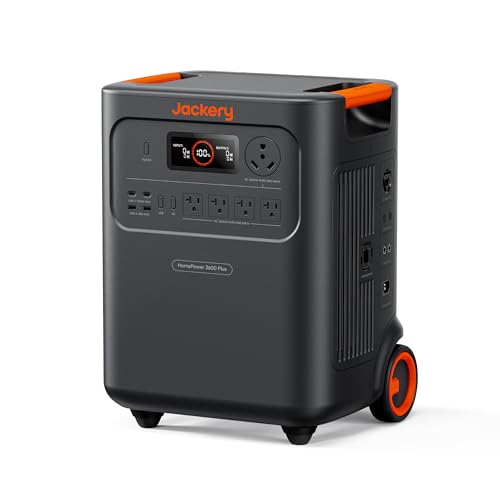
Jackery HomePower 3600 Plus Power Station
Best for: Whole-home emergency backup and heavy appliances
Pros
- 3584Wh capacity expandable up to 43kWh
- 3600W output with 240V parallel support
- High-temperature ceramic membrane battery cells
Cons
- Substantial 77.2-pound physical weight
- Only two AC outlets listed in specifications
The Jackery HomePower 3600 Plus Power Station represents the upper echelon of high-output residential and basecamp backup solutions. Supplying an enormous 3584Wh capacity and a 3600W AC output, it can be bridged in parallel to achieve 7200W total output with dual 120V and 240V capability, making it fully competent at driving heavy-load appliances such as well pumps, space heaters, and clothes dryers. The unit is constructed around automotive-grade cell-to-body technology and heat-resistant ceramic membrane battery cells tested at 302 degrees Fahrenheit to prevent thermal runaway. These rugged cells deliver 6000 operating cycles, a 10-year lifespan, and reliable discharge performance even during blizzards at minus 4 degrees Fahrenheit.
Despite its substantial 77.2-pound operating weight, the station incorporates a luggage-style folding telescopic handle and durable wheels that allow users to roll the hardware smoothly between storage closets, kitchens, and garages. Recharging is remarkably versatile with four distinct options: a rapid 2-hour full charge via hybrid AC and DC inputs, 2.5 hours through standard AC wall power, 4 hours using a compatible solar array, or 2.5 hours from an external gas generator. Those seeking scalable off-grid endurance can connect an external jackery expansion battery pack system to scale capacity from 3584Wh up to 21kWh on a single base unit, or 43kWh across multiple linked units.
This stationary generator is targeted at homeowners needing plug-and-play manual transfer switch integration during prolonged severe weather blackouts, as well as high-draw remote production basecamps. Its two onboard outlets deliver uncompromising output for heavy electrical appliances. However, its heavy 77.2-pound chassis makes it entirely impractical for mobile backpackers or solo field creators, where the lighter Explorer line is far better suited. The unit carries model designation JHP-3600A and comes in a sleek black housing.
04
Jackery HomePower 3000 Portable Power Station

Jackery HomePower 3000 Portable Power Station
Best for: RV road trips and home emergency circuits
Pros
- Built-in TT-30 RV plug for campers
- Sub-20 millisecond UL-certified UPS mode
- Compact CTB honeycomb shell design
Cons
- Listing does not specify exact physical weight
- Requires dual 200W panels for solar speed
The Jackery HomePower 3000 Portable Power Station is built for residential backup, extended road travel, and recreational vehicle adventures. Packing 3072Wh of internal capacity, it provides a 3600W running output backed by a massive 7200W starting surge. A defining feature for mobile living is its built-in TT-30 RV port, which offers plug-and-play hookup for camper vans and travel trailers without needing awkward outlet adapters. The station includes four total power outlets, combining AC receptacles, dual 100W USB-C Power Delivery ports, USB-A outputs, and DC ports to keep vital devices, mobile workstations, and domestic appliances running simultaneously.
For home resilience, the unit features a UL-certified uninterruptible power supply mode that switches from grid to battery power in 20 milliseconds or less. This near-instant switchover keeps desktop computers, live broadcasts, security systems, and medical refrigerators running without interruption during sudden blackouts. The battery architecture relies on durable LiFePO4 cells offering 4000 cycles to 70 percent retention, monitored by ChargeShield 2.0 artificial intelligence algorithms. Recharging takes 1.7 hours using combined hybrid AC and DC charging, 2.2 hours via a standard wall outlet, or 9 hours to reach 80 percent when hooked to two SolarSaga 200W panels. Reviewers comparing jackery solar compatible power stations will find this solar recharge profile ideal for multi-day boondocking.
This model is ideally matched to RV owners, camper van builders, and households seeking dedicated emergency backup that can keep a household refrigerator running for 15 hours. The listing emphasizes that its cell-to-body engineering and honeycomb bottom shell make it 47 percent smaller and 43 percent lighter than comparable 3kWh power stations, though the listing does not specify its exact numeric weight in pounds. When users need 240V parallel capability or modular expansion up to 43kWh, this unit gives way to the HomePower 3600 Plus.
05
Jackery Explorer 500 v2 Portable Power
Best for: Weekend car camping and mobile workstations
Pros
- Recharges to 80 percent in 52 minutes
- 6000-cycle LiFePO4 battery with 10ms UPS
- Built-in LED task light and folding handle
Cons
- 500W output limits high-draw appliances
- Spec table lists only one total outlet
The Jackery Explorer 500 v2 Portable Power station strikes an appealing compromise between the handheld Explorer 300 and the heavier Explorer 1000 v2. Housing a 512Wh battery capacity and a 500W pure sine wave AC inverter with a 1000W surge peak, it reliably supports laptop computers, camera charging docks, mini-refrigerators, and field monitors. It weighs 14 pounds, making it easy to carry with its folding handle, and incorporates an emergency LED light on the chassis to illuminate campsites or work surfaces during unexpected darkness.
Recharging speed is a standout metric: the Explorer 500 v2 charges from zero to 80 percent in just 52 minutes when plugged into a standard AC wall receptacle. It also accepts 12V automotive charging and solar panel input managed by an integrated MPPT charge controller. The LiFePO4 battery pack is rated for an exceptional 6000 charge cycles, delivering more than a decade of regular use, and features an ultra-low self-discharge rate that loses only 5 percent of its charge after six months in storage. It also functions as a 10ms uninterruptible power supply operating at an ultra-quiet 28 dB sound level, making it unobtrusive inside tents, vehicles, or home offices.
This station is perfect for weekend road trippers, audio field recordists, and content creators running multi-battery charging hubs away from grid outlets. Its 500W continuous output provides greater flexibility than smaller 300W units while remaining half the weight of the Explorer 1000 v2. The package includes the Explorer 500 v2, an AC wall charging cable, a 16.4-foot extension cable, and a user manual. Note that solar panels are sold separately, the specification sheet lists one total outlet, and orders require a physical delivery address.
06
Jackery Solar Generator 300 and 40W
Best for: Off-grid beginners wanting an all-in-one bundle
Pros
- Bundled with 40W Air Solar Panel
- Lightweight 7.5-pound compact build
- Powers 6 devices including 100W USB-C PD
Cons
- Solar panel and station may ship separately
- 300W maximum limits heavy gear
The Jackery Solar Generator 300 and 40W bundle provides an all-in-one solar capture and power storage solution straight out of the box. Pairing the 292Wh Explorer 300 station with an included 40W Air Solar Panel, this package ensures you have an immediate off-grid power generation system without having to research separate panel compatibility. The station supplies a 300W rated AC output with a 600W surge peak, supporting six devices simultaneously across two AC outlets, a 100W USB-C Power Delivery port, two USB-A ports, and a 120W DC car port.
Weighing 7.5 pounds, the power station retains the sleek, integrated handle design of the standalone Explorer 300, making it an easy companion for hunting trips and remote outdoor filming sessions. The internal LiFePO4 cells are rated for more than 4000 charge cycles to 70 percent capacity, delivering 11-plus years of service. Connected to the bundled 40W solar panel, the station reaches an 80 percent charge in approximately 7.5 hours under clear skies. It can also recharge in roughly 2.8 hours if later connected to an optional 100W panel. Shoppers interested in an entry-level jackery portable power station with solar panels will appreciate having matching hardware ready to deploy.
This kit is tailored for backpackers, solo day-hikers, and tent campers who want an off-grid setup for smartphones, headlamps, cameras, and GPS units. It removes the guesswork of selecting compatible solar accessories, though the listing notes that the generator and solar panel may ship in separate parcels. Because of its 300W limit, it cannot support coffee makers, induction burners, or high-draw construction tools, which require stepping up to the Explorer 1000 v2 or HomePower lines. The box includes the Explorer 300 station, the 40W Air Solar Panel, an AC adapter, a car charger cable, and a user guide.
Matching a Model to Your Setup
- Solo vloggers, drone operators, and minimalist trail hikers will get the best balance of low carry weight and multi-device charging from the lightweight Jackery Explorer 300.
- Off-grid weekend campers wanting a complete, out-of-the-box solar capture kit without buying extra cables should pick the Jackery Solar Generator 300 and 40W.
- Outdoor content creators needing fast wall recharging, 10ms silent backup, and enough wattage for mobile workstations will find the ideal sweet spot in the Jackery Explorer 500 v2.
- Independent video crews running high-output LED field lights, camera docks, and portable coolers will benefit most from the 1500W output and 1-hour fast charge of the Jackery Explorer 1000 v2.
- Recreational vehicle travelers and van builders needing an integrated TT-30 RV receptacle and rapid uninterruptible power supply switching should choose the Jackery HomePower 3000.
- Homeowners looking for whole-house emergency resilience capable of powering 240V appliances and expanding battery capacity up to 43kWh should invest in the Jackery HomePower 3600 Plus.
Before You Buy
Reviewing the product listings reveals several crucial equipment exclusions that buyers must keep in mind before placing an order. Standalone models—specifically the Jackery Explorer 1000 v2, Explorer 300, Explorer 500 v2, HomePower 3000, and HomePower 3600 Plus—do not come with solar panels included in the box. If you intend to harvest solar energy in the field, solar panels must be purchased separately. Furthermore, the Explorer 1000 v2 listing explicitly states that it is compatible only with Jackery brand solar panels, restricting third-party panel integration. Across all listings, Jackery notes that shipments cannot be delivered to postal box addresses, requiring an actual physical street address for successful order fulfillment.
There are also specific technical gaps and discrepancies within the manufacturer listing data. For the Jackery HomePower 3000, while the listing highlights that cell-to-body technology makes it 43 percent lighter and 47 percent smaller than competing 3kWh units, the listing does not specify the exact numeric weight in pounds within its technical specification table. Additionally, outlet counts present slight contradictions across listings: the Explorer 500 v2 lists two pure sine wave AC outlets in its descriptive bullet points but records a total outlet count of one in the specification table. Similarly, the HomePower 3600 Plus lists only two outlets in its specification table despite its high output capacity. Checking these connector details against your exact device plugs ensures your setup connects seamlessly on arrival.
FAQ
Which Jackery portable power station to buy for outdoor field shoots?
For most video and photography field shoots, the Jackery Explorer 1000 v2 is the most practical choice. Its 1500W output supports high-draw studio lights, laptop charging, and camera battery docks simultaneously, while its 23.8-pound weight and folding handle remain manageable for vehicle-based creators. If your gear bag is limited to lightweight drone batteries and mirrorless cameras, the 7.1-pound Explorer 300 offers a far more compact alternative.
Can a Jackery battery generator for camping run medical devices like CPAP machines?
Yes, several Jackery models are well-suited for running CPAP machines while camping. The Jackery Explorer 300 explicitly highlights CPAP camping suitability, offering clean power through its pure sine wave AC outlets or 12V DC car port. For extended multi-night trips where recharging may not be accessible daily, stepping up to the Explorer 500 v2 or Explorer 1000 v2 provides greater watt-hour reserves to ensure uninterrupted overnight operation.
What is the difference between the Explorer series and the HomePower series?
The Explorer series focuses on portable, grab-and-go energy storage ranging from 292Wh to 1070Wh, featuring integrated handles and lightweight builds tailored for travel, camping, and mobile content creation. The HomePower series consists of heavy-duty units delivering 3072Wh to 3584Wh with 3600W outputs, designed for stationary home backup or RV use with features like built-in TT-30 RV plugs, luggage-style rolling wheels, parallel expansion, and sub-20ms uninterruptible power supply switching.
How fast do Jackery LFP power stations recharge from an AC wall outlet?
Recharge speeds vary depending on the model and selected charging mode. The Explorer 500 v2 reaches an 80 percent charge in 52 minutes via standard wall power, while the Explorer 1000 v2 can achieve a full zero-to-100 percent charge in one hour when emergency charging is activated in the Jackery App. The larger HomePower 3000 recharges in 2.2 hours via AC power, and the HomePower 3600 Plus completes an AC wall charge in approximately 2.5 hours.
Are third-party solar panels supported on Jackery power stations?
While some models support standard DC solar inputs via appropriate adapters, the listing for the Jackery Explorer 1000 v2 explicitly states that it is compatible only with Jackery brand solar panels. For other models, such as the HomePower series and smaller Explorer units, Jackery emphasizes optimized pairing with their own SolarSaga series panels to ensure rated solar recharge times and proper electrical protection.


