As Amazon Associates, we earn from qualifying purchases. This means we may receive a small commission at no extra cost to you if you click through and make a purchase.
Content creators, video editors, and audio producers frequently battle excess ambient heat from high-wattage lighting, multi-monitor editing desks, and GPU render loads. Conventional portable air conditioners often force an unwanted compromise between room temperature and background noise during recording sessions. Standard single-hose models expel room air outdoors, creating negative pressure that draws hot, humid air inside through door crevices. A whynter dual hose portable air conditioner isolates intake and exhaust airflow loops to maintain balanced indoor pressure while protecting sensitive studio equipment.
According to manufacturer listings, Whynter organizes its dual-hose lineup into two distinct designs: classic rotary scroll platforms and variable-speed inverter systems. Classic units use single-speed compressors that operate at fixed thresholds, providing dependable mechanical operation and heavy dehumidification without digital controls. Inverter models modulate compressor frequency to match cooling demands, reducing power draw, preventing abrupt mechanical compressor clicks, and lowering operating noise floors. Deciding which whynter portable air conditioner to buy depends on room dimensions, acoustic tolerances during recording, and smart ecosystem requirements.
This guide by the numbers
4.7/5
Best rated model
Highest buyer average in this line-up, as left by Amazon shoppers
3
Models on file
Models in this guide that have a stored product record
1
Brand involved
Distinct brand names on the product records used here
Figures come from the stored Amazon listing data for the products in this article. Ratings are buyer averages, not scores given by this site.
Whynter Portable Air Conditioner Lineup at a Glance

Whynter Portable Air Conditioner Inverter 14000
Best for: Acoustic studios demanding maximum cooling and silence
Pros
- Ultra-low 42.5 dBA noise level
- Innovative hose-in-hose design
- 12,000 BTU SACC capacity
- 40% more efficient inverter
Cons
- Larger 32.5-inch tall chassis
- Hose extends up to 47 inches
Whynter Portable Air Conditioner 12,000 BTU
Best for: Creators seeking quiet classic controls on low speed
Pros
- Quiet 47 dBA low speed
- 82 pint daily dehumidification
- Includes protective storage bag
- Separate dual-hose ducting
Cons
- Non-inverter rotary scroll compressor
- Lower 7,000 BTU SACC rating

Whynter Portable Air Conditioner 13000 BTU
Best for: Tech-focused studios needing smart app climate control
Pros
- NEX Inverter efficiency
- Motorized 80-degree louver
- Wi-Fi and voice control
- 5-speed fan versatility
Cons
- Higher 50 dBA noise floor
- Excludes intake hose-in-hose design
| Model | Cooling Capacity | Compressor Architecture | Noise Level | Airflow Configuration |
|---|---|---|---|---|
| Whynter Portable Air Conditioner 13000 BTU | 13,000 BTU ASHRAE / 10,000 BTU SACC | NEX Inverter Compressor | 50 dBA | Dual Hose System |
| Whynter Portable Air Conditioner 12,000 BTU | 12,000 BTU ASHRAE / 7,000 BTU SACC | Rotary Scroll Non-Inverter | 47 dBA (Low) | Separate Dual Hose |
| Whynter Portable Air Conditioner Inverter 14000 | 14,000 BTU ASHRAE / 12,000 BTU SACC | Rotary Scroll Inverter | 42.5 dBA | Hose-in-Hose Dual Design |
The Models in Detail
01
Whynter Portable Air Conditioner 13000 BTU
The Whynter Portable Air Conditioner 13000 BTU (ARC-1280WX) combines smart automation with variable-speed compressor cooling for spaces up to 500 square feet. The listing specifies 13,000 BTU ASHRAE (10,000 BTU SACC) cooling power powered by an efficient NEX Inverter compressor running on R-32 refrigerant. Drawing 1212 watts on 115-volt power, it achieves an Energy Efficiency Ratio of 9.9. For studio spaces with hot workstations, an automatic 80-degree flexible airflow louver distributes air evenly to eliminate thermal hot spots around editing desks.
The unit features smart Wi-Fi integration via the NetHome Plus app, supporting voice control through Apple Siri, Amazon Alexa, and Google Home. Operational noise ranges between 50 and 56 dBA, paired with a five-speed fan that lets creators adjust airflow velocity during sensitive audio tasks. Air filtration uses a washable air filter alongside an activated carbon filter to collect dust and neutralize studio odors. The white chassis includes self-evaporation, a 24-hour timer, sleep mode, and a 60°F to 86°F thermostat. In our broader whynter ac unit comparison, this model stands out for its five-speed fan control and hands-free voice integration.
This model suits live streamers, video editors, and animators working in mid-sized studios who need remote scheduling and flexible airflow adjustments without leaving their desk. The five fan speeds help minimize air rush noise during voice tracking. However, creators in dedicated sound booths who require an even lower noise floor will find the 42.5 dBA 14,000 BTU model a quieter choice. Users who prefer mechanical buttons over mobile apps can turn to the classic 12,000 BTU unit instead.
02
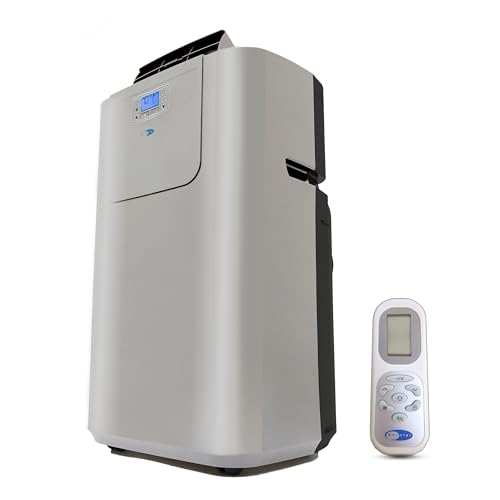
Whynter Portable Air Conditioner 12,000 BTU
The Whynter Portable Air Conditioner 12,000 BTU (ARC-122DS) is a classic dual-hose unit engineered for spaces up to 400 square feet. The listing indicates 12,000 BTU ASHRAE (7,000 BTU SACC) cooling capacity, operating at 1200 watts and 10.5 amps on 115V power. Built with an aluminum alloy core and a rotary scroll compressor using R-32 refrigerant, it uses two independent hoses: a 5.9-inch diameter exhaust hose extending up to 60 inches and a 5.0-inch intake hose that balances indoor air pressure.
A key asset for creator spaces is its 47 dBA sound rating on low fan speed. The unit offers three operational modes—cooling, dehumidifying, and fan circulation—with a three-speed fan moving 194 CFM of air. Its built-in dehumidifier removes up to 82 pints of moisture daily, protecting condenser microphones, audio interfaces, and instrument wood from humidity damage. The 16-by-17-by-29.5-inch gray chassis includes an activated carbon filter, a washable pre-filter, a 20-to-56-inch window kit, and a protective storage bag. When evaluating workshop climate gear alongside units like the midea portable ac 12000 btu design, the ARC-122DS remains a proven choice for mechanical dual-hose cooling.
This unit suits voice actors, audio engineers, and podcasters working in spaces up to 400 square feet who prefer low acoustic rumble on low speed without wireless dependencies. Because it relies on a single-speed rotary scroll compressor without inverter modulation, the compressor clicks when engaging and draws steady operational power. Creators managing heavy heat from multi-GPU rendering setups or larger spaces will find greater cooling capacity in the 13,000 BTU or 14,000 BTU models.
03
Whynter Portable Air Conditioner Inverter 14000
The Whynter Portable Air Conditioner Inverter 14000 (ARC-1230WN) is the manufacturer’s flagship cooling system for residential and creator spaces up to 600 square feet. The listing cites 14,000 BTU ASHRAE capacity (12,000 BTU SACC) powered by a rotary scroll inverter compressor running on R-32 refrigerant. The listing notes this inverter system delivers 20 percent more cooling capacity and over 40 percent greater efficiency than non-inverter models. Crucially for recording environments, it operates at an exceptionally quiet 42.5 dBA, making it the quiet whynter portable air conditioner for noise-critical studio workflows.
The unit features an innovative hose-in-hose assembly, housing both intake and exhaust lines inside a single 47-inch extendable duct. This nested configuration eliminates exhaust heat leakage back into the room. It offers cooling, dehumidification, and fan modes, with an auto-drain system that exhausts up to 87 pints per day of condensate. Drawing 1293 watts and 11.9 amps on 115V power, the 32.5-inch tall white unit includes an 82-inch window kit, a washable filter, and NetHome Plus app control with Alexa and Google Home compatibility. When compared against alternatives across the hisense portable air conditioners category, this nested duct design provides superior window insulation and reduced clutter.
This unit serves as the best whynter dual hose ac for studio control rooms, video production suites, and multi-camera streaming spaces with severe heat loads. The 42.5 dBA noise floor ensures microphones avoid background hum, while inverter speed modulation prevents compressor clicks during recording. It gives way to the 12,000 BTU ARC-122DS only when window dimensions require a smaller frame kit or when users prefer a more compact, gray non-smart chassis.
Matching a Model to Your Setup
- Vocal recording booths and podcast desks: Whynter Portable Air Conditioner Inverter 14000 (ARC-1230WN) delivers an ultra-quiet 42.5 dBA noise floor with smooth inverter modulation to prevent audio spikes.
- Connected video editing workstations: Whynter Portable Air Conditioner 13000 BTU (ARC-1280WX) offers five fan speeds, motorized 80-degree louvers, and voice control via Siri, Alexa, and Google Home.
- High-humidity project studios: Whynter Portable Air Conditioner 12,000 BTU (ARC-122DS) provides 82-pint daily moisture removal, simple manual controls, and a quiet 47 dBA low-speed mode.
- Multi-computer streaming studios up to 600 square feet: Whynter Portable Air Conditioner Inverter 14000 (ARC-1230WN) offers 12,000 BTU SACC capacity and an insulated hose-in-hose design.
- Compact creative workspaces under 400 square feet: Whynter Portable Air Conditioner 12,000 BTU (ARC-122DS) fits smaller footprints while balancing room pressure using independent dual hoses.
Before You Buy
Before purchasing a dual-hose unit, verify that your window opening supports the included horizontal or vertical sliding window kits. The listings specify maximum window kit lengths—ranging from 56 inches on the 12,000 BTU unit to 82 inches on the 14,000 BTU model—but they do not specify compatibility with casement, awning, or crank-out windows. If your studio features non-sliding windows, custom acrylic panels or third-party fabric seals will be required. Furthermore, while dual-hose systems prevent room depressurization, the listings do not specify that exhaust hoses radiate warm surface heat, meaning keeping hose runs short and straight is necessary to maximize thermal efficiency.
The product listings also do not provide decibel ratings across all intermediate fan speeds, stating primarily the lowest attainable noise level under optimal conditions. While minimum ratings of 42.5 dBA to 47 dBA are quiet, operating at higher fan speeds increases background noise within compact recording spaces. Additionally, the listings do not specify drain hose diameters for continuous gravity drainage or replacement timelines for the activated carbon filters. Creators should also ensure their studio circuit breaker can handle a 10.5 to 11.9 amp continuous load alongside workstation PCs, monitors, and studio lighting gear.
FAQ
Why is a dual hose portable air conditioner better for a creative studio than a single hose unit?
Single-hose air conditioners exhaust conditioned room air outdoors to cool the internal condenser, creating negative air pressure in the room. This vacuum forces warm, humid, dusty outdoor air inside through door gaps and wall crevices. A dual-hose system isolates the condenser airflow entirely: one hose pulls outdoor air across the condenser while the other exhausts the heat back outside. This maintains balanced room pressure, preserves acoustic seals, and prevents dust from settling on studio microphones and computer gear.
How does inverter technology reduce acoustic interference during audio recording?
Traditional portable air conditioners use single-speed compressors that run at full capacity and shut off abruptly when target temperatures are reached, creating mechanical thuds and electrical clicks on audio tracks. A whynter dual hose inverter air conditioner dynamically adjusts compressor speed to match thermal demand. By eliminating abrupt on-off cycling, inverter units produce a consistent, low-frequency hum that is easy to remove using audio gates or directional microphones during recording sessions.
What does the SACC rating mean in a whynter portable ac btu comparison?
In any whynter portable ac btu comparison, shoppers will see both ASHRAE and SACC ratings. The ASHRAE figure reflects gross laboratory cooling power, while the Department of Energy SACC rating accounts for real-world factors like duct heat radiation and air leakage. The ARC-1230WN provides 14,000 BTU ASHRAE (12,000 BTU SACC), the ARC-1280WX delivers 13,000 BTU ASHRAE (10,000 BTU SACC), and the ARC-122DS offers 12,000 BTU ASHRAE (7,000 BTU SACC). SACC ratings offer a realistic metric of cooling performance against hot studio gear.
How does the Whynter hose-in-hose design differ from standard dual hose setups?
Standard dual-hose systems like the ARC-122DS run two separate flexible hoses from the unit to the window bracket, requiring wider openings and creating dual heat-radiating surfaces. The ARC-1230WN nests the intake duct inside the exhaust line within a single 47-inch flexible hose. This configuration simplifies window installation, minimizes cable and duct clutter behind workstations, and creates an insulating air barrier that prevents hot exhaust air from warming the studio space.
Can I run a Whynter portable air conditioner on the same electrical circuit as studio equipment?
All three Whynter portable air conditioners run on 115-volt residential power, drawing between 1200 and 1293 watts, which translates to 10.5 amps on the ARC-122DS and 11.9 amps on the ARC-1230WN. Because residential studio rooms often share a 15-amp branch circuit, running a portable AC on the same circuit as a high-wattage PC, studio monitors, and video lights can risk tripping breakers during compressor startup. Operating the air conditioner on a separate dedicated circuit is strongly recommended.