As Amazon Associates, we earn from qualifying purchases. This means we may receive a small commission at no extra cost to you if you click through and make a purchase.
Selecting a vevor borescope camera requires balancing probe maneuverability, optical layout, cable stiffness, and display ergonomics. Hobbyists, automotive technicians, and bench tinkerers frequently inspect dark, obstructed cavities where direct visual access is impossible. Deciding which vevor borescope camera to buy depends heavily on whether your teardowns involve weaving through tight engine cylinder spark plug holes, inspecting valves from behind, or running extended lengths through drywall framing and HVAC ductwork.
The VEVOR inspection camera catalog divides into two distinct operational approaches. The first group prioritizes articulation, utilizing mechanical 4-way cable steering on compact 4.9-foot flexible lines to inspect valve faces, combustion chambers, and complex machinery housings without hand-twisting. The second group emphasizes reach and multi-angle viewing, employing 16.4-foot semi-rigid snake cables with dual front and side lenses or motorized rotation. Across both categories, VEVOR integrates dedicated IPS displays, onboard LED illumination, and IP67 waterproof probe heads, eliminating the need to tether sensitive smartphones in wet or oily environments.
This guide by the numbers
9.6/10
Best rated model
Our highest score in this line-up
4
Models on file
Models in this guide that have a stored product record
1
Brand involved
Distinct brand names on the product records used here
Prices and specifications come from the stored Amazon listing data for the products in this article. Scores are out of 10, based on listed specifications and buyer feedback.
VEVOR Borescope Camera Lineup at a Glance
| Model | Steering and Optics | Probe Diameter and Cable | Display and Power |
|---|---|---|---|
| VEVOR 4-Way Articulating Borescope with Light | 4-Way Manual Articulation, 1080p Single Lens | 0.24 in (6 mm), 4.9 ft Flexible Snake | 6.0 in IPS, 7000mAh Battery |
| VEVOR Endoscope Camera with Light | Dual-Lens (Front + Side), 1080p | 8 mm (0.315 in), 16.4 ft Semi-Rigid | 4.3 in IPS, 2000mAh Battery |
| VEVOR 4-Way Articulating Endoscope with Light | 4-Way Manual Articulation, 1080p Single Lens | 0.32 in (8 mm), 4.9 ft Flexible Snake | 4.5 in IPS, 3000mAh Battery |
| VEVOR 360° Borescope with Innovative 360° | Motorized 360° Rotation, Dual-Lens 1080p | 0.32 in (8 mm), 16.4 ft Rigid Snake | 5.0 in IPS, 5000mAh Battery |
The Models in Detail
01
VEVOR 4-Way Articulating Borescope with Light

VEVOR 4-Way Articulating Endoscope with Light
Best for: Field mechanics needing a compact articulating probe
Pros
- Full 4-way probe steering
- Lightweight 4.5-inch IPS display
- Sharp 1080p sensor with 6 LEDs
Cons
- Wider 0.32-inch probe head
- Moderate 3 to 4 hour runtime
VEVOR 4-Way Articulating Borescope with Light
Best for: Automotive technicians inspecting tight engine valves
Pros
- Slim 0.24-inch camera head
- Large 6-inch IPS screen
- High-capacity 7000mAh battery
- Responsive 4-way articulation
Cons
- Short 4.9-foot cable reach
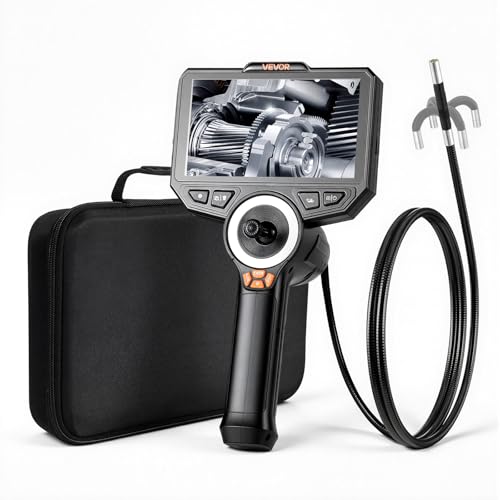
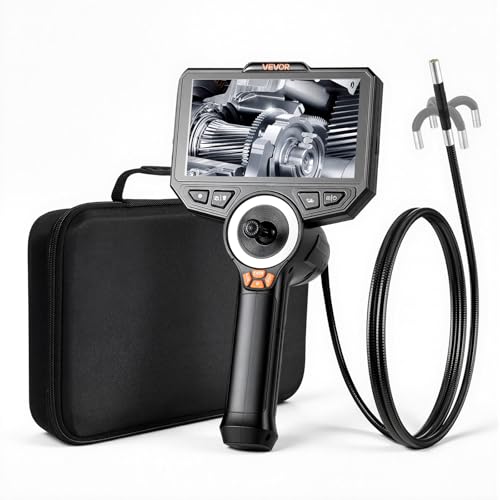
The VEVOR 4-Way Articulating Borescope with Light is built for tight mechanical teardowns where probe diameter and steering precision determine whether an inspection succeeds. It features a true 1080p sensor housed within an ultra-slim 0.24-inch camera head. By integrating 4-way articulation, the user controls the viewing angle directly from the base console, turning the camera tip 360 degrees inside narrow passages without needing to twist the entire cable. This setup makes it straightforward to point the camera backward to inspect intake valves, cylinder head walls, and internal transmission gears.
To support bench work and garage diagnostics, the console features a 6-inch IPS screen with digital image stabilization and 8x digital zoom. The display provides a wider viewing angle and sharper contrast than smaller handheld units, helping users spot micro-cracks and gasket flaws without squinting. Power comes from an integrated 7000mAh rechargeable battery that delivers between 5 and 6 hours of continuous operation on a single charge. The probe is rated IP67 waterproof, enabling safe operation in wet, oily automotive environments, while files write to a Micro SD card via a USB Type-C interface.
This model suits automotive mechanics, engine rebuilders, and electronics hobbyists who need maximum probe agility inside cramped enclosures. The 4.9-foot flexible snake cable provides responsive steering, though it lacks the push stiffness required for long structural plumbing or HVAC duct inspections. When your diagnostic workflow demands reaching deep down long conduits rather than looping inside a cylinder, this unit gives way to the longer semi-rigid options in the lineup.
02
VEVOR Endoscope Camera with Light

VEVOR Endoscope Camera with Light
Best for: Plumbers and HVAC technicians running long lines
Pros
- Dual front and side lenses
- Long 16.4-foot semi-rigid cable
- Included hook magnet and mirror
- Supports RAW image capture
Cons
- Fixed non-articulating camera tip
- Smaller 2000mAh battery capacity
The VEVOR Endoscope Camera with Light focuses on extended reach and multi-angle viewing. Classified as a dual lens industrial borescope vevor users rely on for general troubleshooting, it integrates both a forward-facing camera and a 90-degree side-facing camera on an 8 mm probe tip. The dual-perspective arrangement allows you to examine pipe walls or wiring channels without physical articulation. Illumination is managed by an 8 + 1 LED light array with three adjustable brightness levels to illuminate dark voids without washing out reflective surfaces.
The handheld unit is equipped with a 4.3-inch IPS monitor delivering 1080p resolution for both still photography and video recording. It supports multiple recording formats, including JPEG, RAW, MP4, AVI, and MOV, and incorporates 1x to 4x digital zoom alongside a 180-degree image rotation feature to orient upside-down feeds. A 16.4-foot semi-rigid vevor snake camera cable provides the structural column strength needed to bridge vertical wall chases, floor joists, and sewer branches. Packaged with a 32GB TF card, Type-C charging port, and clip-on hook, magnet, and mirror accessories, it acts as a standalone diagnostic package comparable to bench tools like the anykit endoscope camera with light.
This setup is suited for home inspectors, plumbers, and general maintenance specialists checking drainage lines, behind-wall framing, and long runs of ductwork. Powered by a 2000mAh battery, it handles typical diagnostic checks with ease. However, because the camera head remains fixed on the cable end, users cannot actively steer around sharp internal mechanical bends, making it less practical for internal engine inspections than an articulating probe.
03
VEVOR 4-Way Articulating Endoscope with Light
The VEVOR 4-Way Articulating Endoscope with Light offers dedicated mechanical articulation in a compact handheld chassis. Using an intuitive control mechanism on the handle, this vevor articulating endoscope directs the camera probe in four directions, providing full 360-degree coverage inside concealed spaces. Its 4.9-foot flexible snake cable easily bends through convoluted pathways, while the 0.32-inch camera head navigates spark plug openings, exhaust manifolds, and machinery housings without jamming.
Visual feedback is handled by a 4.5-inch IPS display backed by hardware image enhancement to produce accurate colors and distinct edge contrast. The 1080p camera sensor captures 2.07-megapixel stills and crisp video feeds, supplemented by 6 adjustable LED lights that reduce glare and shadow wash. The probe carries an IP67 waterproof certification to withstand immersion in water, motor oil, and coolant. It houses a 3000mAh internal battery rated for 3 to 4 hours of uninterrupted runtime, with recording routed to a Micro SD card through a USB-C interface.
This model is built for mobile diagnostic technicians, HVAC service staff, and field mechanics who need a lightweight, packable vevor 4-way articulating borescope. While its 0.32-inch probe head is slightly larger than the 0.24-inch flagship and its battery capacity is moderate, its compact form factor fits easily into a standard mobile field kit. For users working exclusively on deep engine cylinders with restrictive clearances, the slimmer 0.24-inch variant remains the better fit.
04
VEVOR 360° Borescope with Innovative 360°

VEVOR 360° Borescope with Innovative 360°
Best for: Industrial inspectors examining complex pipe networks
Pros
- Motorized 360-degree rotation
- Dual front and side lenses
- Split-screen simultaneous display
- Large 5000mAh battery
Cons
- Bulkier probe head for tight bores
The VEVOR 360° Borescope with Innovative 360° combines long-range reach with automated optical orientation. Instead of relying on manual wrist adjustments, this vevor 360 borescope features a motorized 360-degree rotating probe head paired with dual front and side viewing lenses. This system allows operators to remotely spin the camera view while the probe is deep inside an enclosed pathway, making it easy to survey radial pipe walls, structural weld seams, and internal conduit surfaces from any angle.
The console features a 5-inch IPS display with a built-in split-screen function that renders front and side camera feeds simultaneously. This split-view capability speeds up comprehensive diagnostics by monitoring forward obstacles while inspecting sidewall condition in real time. The camera head measures 0.32 inches in diameter and is supported by 6 + 1 adjustable LEDs. A 16.4-foot rigid snake cable provides the necessary push resistance to navigate deep pipe networks and structural machinery, such as alignment channels adjusted with heavy workshop equipment like a vevor porta power setup. Power is supplied by a 5000mAh battery that delivers 5 to 6 hours of continuous operation.
This unit is suited for industrial pipe maintenance, commercial HVAC inspection, and large engine servicing where manual cable twisting is impossible over extended distances. It provides the longest reach among VEVOR’s steerable inspection cameras. However, the rigid cable design is bulkier and less compliant in tight, winding automotive assemblies than the shorter, fully flexible articulating cables.
Matching a Model to Your Setup
Every workshop inspection brings distinct geometric limitations, cable reach demands, and lighting challenges. Selecting the best vevor borescope camera requires pairing the probe mechanics to your specific inspection environment:
- Precision engine teardowns and valve checks: The VEVOR 4-Way Articulating Borescope with Light excels here due to its slim 0.24-inch camera tip, 4-way articulation, and massive 6-inch IPS screen that reveals carbon build-up and valve seat wear.
- Plumbing runs and structural wall chasing: The VEVOR Endoscope Camera with Light is the practical choice, offering a 16.4-foot semi-rigid cable, dual front and side cameras, and utility attachments like a retrieval hook and magnet.
- Mobile field service and quick diagnostics: The VEVOR 4-Way Articulating Endoscope with Light offers the best balance of portability and steering control, featuring a 4.5-inch display and 4-way probe articulation that packs neatly into small tool bags.
- Long industrial pipe and duct maintenance: The VEVOR 360° Borescope with Innovative 360° is designed for deep runs where manual rotation fails, using motorized 360-degree camera rotation, split-screen viewing, and a 16.4-foot rigid push cable.
- Electrical conduit and drop ceiling sweeps: The VEVOR Endoscope Camera with Light or VEVOR 360° Borescope provides the required semi-rigid column strength to span wide ceiling gaps without sagging prematurely.
Before You Buy
Before purchasing, buyers should note specific technical boundaries that the product listings do not specify. The manufacturer listings do not state the exact minimum and maximum focal distances for any of these camera heads. While industrial borescopes generally focus best in macro ranges between one and four inches, the listings do not quantify the depth of field or clarify whether the cameras can resolve fine detail at distances greater than six inches. Furthermore, the minimum bend radius for the articulating models is omitted, meaning users must use care not to force the articulated tips through excessively sharp pipe elbows.
Additionally, operating temperature boundaries for hot environments are not detailed in the specifications. When diagnosing vehicles or machinery like mechanical drives and processing equipment such as a vevor grain mill grinder, engines and housings must be allowed to cool completely, as excessive heat can permanently damage optical sensors and articulation cables. Finally, while one package specifies an included 32GB card, the listings do not specify the maximum supported Micro SD card capacity across all consoles, making it wise to stick with standard 32GB or 64GB FAT32-formatted cards.
FAQ
How does an articulating borescope differ from a dual-lens camera?
An articulating borescope uses mechanical cables to physically turn the camera tip up to 180 degrees in multiple directions, allowing you to look backward at valves or around corners. A dual-lens camera has fixed forward and side lenses that switch digitally. Dual lenses provide quick 90-degree viewing along pipe walls, but cannot sweep smooth intermediate angles like an articulated tip.
Can VEVOR borescope cameras be submerged in water or automotive fluids?
The camera heads and cables across all four models feature an IP67 waterproof rating, allowing them to be submerged in water, coolant, and engine oil for brief inspection periods. However, the handheld display consoles are not waterproof and must be kept dry. After exposure to oily fluids, the camera lens should be wiped clean with a microfiber cloth and isopropyl alcohol to maintain optical clarity.
Which VEVOR borescope camera has the smallest probe diameter?
The VEVOR 4-Way Articulating Borescope with Light features the smallest probe in the lineup at 0.24 inches (approximately 6 mm). This narrow diameter makes it the most capable option for passing through small glow plug holes, fuel injector ports, and confined mechanical casings where standard 8 mm probes get stuck.
How do you transfer photos and videos from these inspection cameras?
All four models record footage directly onto removable Micro SD or TF storage cards. Users can remove the card to read files on a computer or connect the console directly using the built-in USB Type-C port. The files are saved in standard multimedia formats such as JPEG, MP4, and MOV, requiring no proprietary viewing software.
Is a semi-rigid cable better than a flexible snake cable?
A semi-rigid cable is better for long horizontal runs and vertical climbs, such as through walls, plumbing, and HVAC ducts, because it holds its shape when pushed. A flexible snake cable is better for short mechanical inspections where a steerable probe tip needs freedom of movement to turn through complex engine passages without resistance.