As Amazon Associates, we earn from qualifying purchases. This means we may receive a small commission at no extra cost to you if you click through and make a purchase.
Selecting an automated cleaning platform for a busy workspace requires balancing debris pickup, floor transition capabilities, and maintenance intervention. When comparing options for a roborock vacuum self emptying system, creators, vloggers, and home studio managers must consider how effectively an autonomous cleaner navigates around lighting stands, loose cords, and delicate equipment. Floor maintenance should operate quietly in the background without interrupting recording sessions, demanding constant bin clearing, or getting trapped against complex furniture legs. While a traditional rumba robot vacuum may handle standard household duties, choosing the best roborock self emptying vacuum involves looking closely at optical sensors, dust station capacity, and mop servicing automation.
Roborock structures its automated cleaner lineup into tiers designed for varying levels of autonomy and floor complexity. The foundational Q-series models concentrate on reliable LiDAR navigation and high-capacity dust collection docks, keeping ongoing debris management simple. Stepping up to the brand’s mid-tier and advanced offerings brings sonic vibration mopping, structured light obstacle avoidance, and motorized edge extensions. At the high end, multi-function docks wash and dry mop pads automatically using heated water and warm air. This roborock robot vacuum comparison evaluates six key models across the brand’s portfolio to help you determine which roborock robot vacuum to buy based on suction power, clearance dimensions, and dock upkeep requirements.
This guide by the numbers
4.7/5
Best rated model
Highest buyer average in this line-up, as left by Amazon shoppers
6
Models on file
Models in this guide that have a stored product record
1
Brand involved
Distinct brand names on the product records used here
Figures come from the stored Amazon listing data for the products in this article. Ratings are buyer averages, not scores given by this site.
Roborock Robot Vacuums Lineup at a Glance
| Model | Suction Power | Dock Capabilities | Navigation & Obstacle Tech |
|---|---|---|---|
| roborock Q7 M5+ Robot Vacuum | 10,000 Pa HyperForce | RockDock Plus (2.7L bag, 7-9 weeks hands-free) | PreciSense LiDAR |
| roborock Q10 S5+ Robot Vacuum | 10,000 Pa HyperForce | RockDock Plus (2.7L bag, up to 70 days) | PreciSense LiDAR with ReactiveTech Structured Light |
| roborock Qrevo S5V Robot Vacuum | 12,000 Pa HyperForce | All-in-One Smart Dock (empty, wash, hot air dry, refill) | PreciSense LiDAR with Reactive Obstacle Avoidance |
| roborock Saros 10R Robot Vacuum | 22,000 Pa HyperForce | Multifunctional Dock 4.0 (176°F wash, 131°F dry, mop removal) | StarSight 2.0 with VertiBeam 3D Sensing |
| roborock 2026 New Qrevo 2 Pro | 20,000 Pa HyperForce | Multifunctional Dock (149°F wash, 113°F dry, tray soaking) | Reactive Tech Obstacle Avoidance & Quick Mapping |
| roborock Q7 L5 Robot Vacuum | 8,000 Pa HyperForce | Integrated 270 ml combo bin (manual emptying) | Precision 360° LiDAR |
The Models in Detail
01
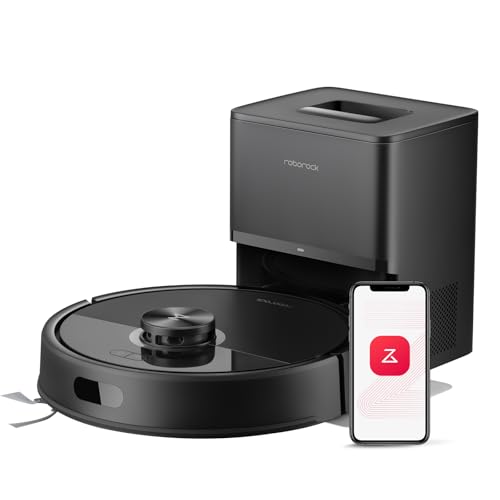
roborock Q7 M5+ Robot Vacuum
roborock Q7 M5+ Robot Vacuum
Best for: Budget studio owners wanting basic self-emptying
Pros
- 10,000 Pa suction power
- Up to 9 weeks dust storage
- JawScrapers anti-tangle brush
- PreciSense LiDAR navigation
Cons
- Passive mopping without auto pad lifting
- No active structured light obstacle sensors
The roborock Q7 M5+ Robot Vacuum is built around dependable floor maintenance with minimal dock interaction, utilizing the RockDock Plus auto-empty station. The dock houses a sealed 2.7-liter dust bag that stores debris for up to 7 to 9 weeks, allowing users to run scheduled cleanings without manually emptying an onboard dustbin after every run. Underneath, a 10,000 Pa HyperForce suction motor pulls fine dust, stray packaging fluff, and pet hair from carpets, marble, tile, and wood floors. The cleaning path spans 12.8 inches, supported by a dual anti-tangle architecture consisting of a JawScrapers main brush and a specialized side brush rated for zero percent hair wrapping.
Navigation relies on the brand’s PreciSense LiDAR system, which actively scans rooms to plot optimized cleaning paths and allows you to establish no-go zones around gear rigs via the Roborock smartphone app. It features a combined vacuum-and-mop mechanism with three adjustable water flow rates, running up to 150 minutes per charge via its lithium-ion battery. This model suits creators working in single-level studios who want long intervals between dock bag changes and strong baseline suction. However, because it lacks active pad-lifting mechanisms and forward structured light sensors, it gives way to the Q10 S5+ when workspaces contain mixed carpets and loose floor cabling that demand active avoidance.
02
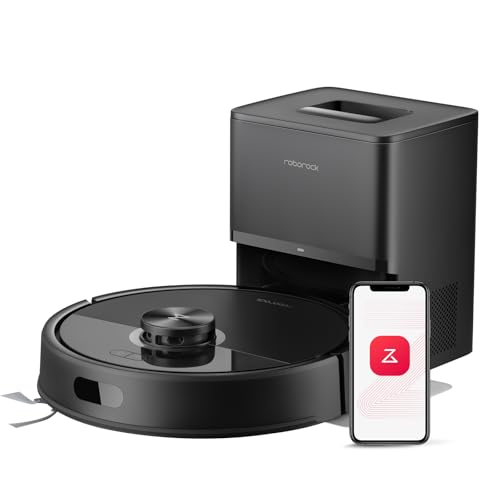
roborock Q10 S5+ Robot Vacuum

roborock Q10 S5+ Robot Vacuum
Best for: Multi-surface workspaces with mixed rugs and floors
Pros
- VibraRise 2.0 sonic scrubbing mop
- 8 mm automatic mop lift
- ReactiveTech obstacle avoidance
- Up to 70 days dock capacity
Cons
- Dock does not wash mop pads
- Standard 150-minute battery life
Stepping up in navigation intelligence and surface versatility, the roborock Q10 S5+ Robot Vacuum introduces ReactiveTech obstacle avoidance. This system utilizes structured light sensors to identify and steer around shoes, low boxes, and floor obstacles without human intervention. Suction remains rated at 10,000 Pa, but wet floor maintenance is significantly upgraded through the VibraRise 2.0 mopping system. The dual-zone sonic scrubbing module vibrates up to 3,000 times per minute to loosen dried spills while automatically lifting the mop pad 8 mm when ultrasonic sensors detect carpets, preventing damp marks on rugs.
Like its sibling, the Q10 S5+ uses a 2.7-liter RockDock Plus auto-emptying station providing up to 70 days of hands-free dirt containment. It also incorporates the JawScrapers comb main brush to mitigate hair entanglements, a 13.9-inch cleaning path width, washable filters, and a 150-minute runtime. Voice integration supports Amazon Echo and Google Home alongside multi-level PreciSense LiDAR mapping. This unit suits content creators who manage mixed hard-floor and rug layouts and require obstacle steering around scattered studio props. However, because its docking station does not wash or dry the mopping pad, it gives way to the Qrevo S5V for users who demand completely automated wet cleaning maintenance.
03
roborock Qrevo S5V Robot Vacuum
roborock Qrevo S5V Robot Vacuum
Best for: Creators needing full wash-and-dry mopping automation
Pros
- All-in-One dock with warm drying
- FlexiArm extendable edge mopping
- 12,000 Pa HyperForce suction
- Zero-tangle certified brush
Cons
- Only supports 2.4 GHz Wi-Fi networks
- Larger footprint for multi-tank dock
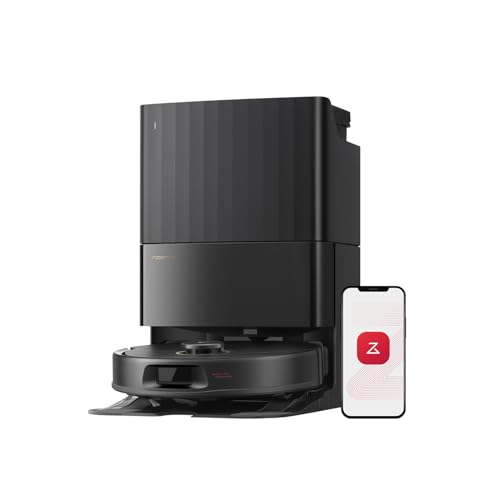
The roborock Qrevo S5V Robot Vacuum expands dock autonomy by combining dry debris extraction with full liquid servicing. Its All-in-One Smart Dock auto-empties dirt into a 10-week storage bag, automatically refills the robot’s water reservoir to cover up to 3,552 square feet, washes the mopping pads, and finishes with warm air drying to prevent odor buildup. Cleaning suction climbs to 12,000 Pa HyperForce, driven by a brushless motor. It features the SGS-certified zero-tangle system, utilizing an arc-shaped side brush and a rubberized floating main brush designed to prevent long hair and fibers from binding the rollers.
For edges and baseboards, the Qrevo S5V employs a FlexiArm system with dual spinning mops rotating at 200 RPM, featuring 30 app-controlled water levels and a 10 mm automatic lift over low-pile carpets. Navigation is handled by PreciSense LiDAR with four-floor mapping, while Reactive Obstacle Avoidance scans for cables, furniture legs, and clutter in real time. Studio owners exploring advanced automated stations like a eufy robot vacuum self-emptying station will appreciate how this unit eliminates manual pad cleaning. This model suits creators needing complete mopping autonomy across large layouts. It gives way to the Saros 10R if your studio requires an ultra-low profile to slide beneath shallow furniture clearances.
04
roborock Saros 10R Robot Vacuum

roborock Saros 10R Robot Vacuum
Best for: Studios with ultra-low furniture and high thresholds
Pros
- Ultra-slim 3.14-inch profile
- 22,000 Pa HyperForce suction
- AdaptiLift chassis climbs 4 cm
- 176°F hot water mop washing
Cons
- No top turret for line-of-sight laser
- Dock requires significant vertical clearance
Engineered for tight clearances and complex architectural obstacles, the roborock Saros 10R Robot Vacuum features an ultra-thin 3.14-inch profile achieved by eliminating the traditional top-mounted LiDAR turret. Instead, it navigates using the StarSight Autonomous System 2.0 with embedded 3D sensing and VertiBeam lateral obstacle avoidance, scanning cables, furniture legs, and narrow spaces with precision. Those comparing low-clearance options like a eufy slim robot vacuum will notice the Saros 10R combines its slim chassis with an immense 22,000 Pa HyperForce suction motor and the Zero-Tangling DuoDivide main brush.
Mobility is enhanced by the industry-first AdaptiLift Chassis, allowing omnidirectional and drive wheels to clear raised door thresholds and U-shaped furniture legs up to 4 cm high. Its Multifunctional Dock 4.0 handles 60-day dust emptying, automated mop removal for vacuum-only passes, 176°F hot water mop washing, and 131°F hot air drying. Control options include an offline “Hello Rocky” voice assistant alongside Apple Siri, Amazon Alexa, and Google Home compatibility. This vacuum suits studios with raised thresholds, suspended cabinets, and low-slung lounge furniture. It gives way to the Qrevo 2 Pro if maximum run duration and ultra-quiet operation take priority over low height and threshold climbing.
05
roborock 2026 New Qrevo 2 Pro
Best for: Busy production spaces needing marathon runtimes
Pros
- 253-minute extended battery life
- 20,000 Pa deep suction
- 15 mm mop lift and pad removal
- Quiet 54 dB operating volume
Cons
- Restricted to 2.4 GHz Wi-Fi bands
- Lacks 4 cm chassis lifting mechanism
The roborock 2026 New Qrevo 2 Pro is optimized for extensive runtime, quiet acoustic performance, and meticulous edge cleaning. Delivering 20,000 Pa HyperForce suction, it operates at a low 54 dB noise level, making it well-suited for creator suites where background hum must remain unobtrusive. Its Dual Zero-Tangle System pairs an anti-tangle side brush with the DuoDivide main roller, while the FlexiArm Edge Mopping system extends outward to clean within 1.85 mm of baseboards and walls, complemented by a reversible side brush delivering 30 percent wider corner reach.
The unit features a 253-minute maximum runtime on a single charge, managed through SmartPlan 3.0 adaptive scheduling and Reactive Tech obstacle detection. The multifunctional dock automatically empties debris, replenishes clean water, washes pads with 149°F high-temperature water, and dries them using 113°F warm air, supported by an upgraded wash tray with soaking mode. Carpet care is thorough: it can automatically detach its mops, vacuum carpets before mopping, or lift the mopping module up to 15 mm. This model suits video editors, podcasters, and busy makers needing marathon runtimes and quiet operation. It gives way to the Saros 10R when clearance under 3.5-inch furniture gaps is an absolute requirement.
06
roborock Q7 L5 Robot Vacuum
Best for: Compact creative offices needing simple laser navigation
Pros
- Precision 360-degree LiDAR mapping
- 8,000 Pa suction power
- Integrated 270 ml combo bin
- Dual anti-tangle brushes
Cons
- Lacks self-emptying dock base
- Requires manual bin and water servicing
The roborock Q7 L5 Robot Vacuum serves as a compact, self-contained cleaning platform that foregoes an external auto-empty base. It utilizes an integrated combo unit containing a 270 ml water tank alongside the internal dustbin, allowing simultaneous vacuuming and mopping with three adjustable water flow rates and a removable pad. Suction power reaches 8,000 Pa HyperForce, supported by dual anti-tangle brushes to keep pet fur and stray threads from clogging the main roller. It runs up to 150 minutes per charge and navigates via real-time 360-degree LiDAR mapping.
App and voice integration let users configure room-specific cleaning schedules, establish virtual boundaries, and engage a child lock for safety around children and pets. The system also flags cable clusters and table legs to suggest automated no-go zones. This model suits hobbyists and creators operating in smaller, single-room edit booths who want precision laser navigation without housing a large docking station footprint. However, because it relies on manual bin emptying and pad maintenance, it gives way to the roborock self emptying vacuum lineup whenever hands-off maintenance is a core priority.
Matching a Model to Your Setup
- Low-clearance furniture and raised room dividers: The roborock Saros 10R Robot Vacuum navigates under furniture as low as 3.14 inches and uses its AdaptiLift chassis to step over 4 cm thresholds.
- Live broadcast spaces and recording suites: The roborock 2026 New Qrevo 2 Pro delivers quiet 54 dB cleaning, 20,000 Pa suction, and a marathon 253-minute battery life to clean large footprints without audio disruption.
- High-traffic studios requiring zero mop maintenance: The roborock Qrevo S5V Robot Vacuum provides warm-air pad drying, automated water refills, and 12,000 Pa suction to keep hard floors spotless without manual scrubbing.
- Mixed hard floors and area rugs with loose gear: The roborock Q10 S5+ Robot Vacuum uses ReactiveTech structured light to dodge cables while its VibraRise 2.0 system lifts mop pads 8 mm over rugs.
- Basic studio floor care with minimal dock interaction: The roborock Q7 M5+ Robot Vacuum provides 10,000 Pa suction and up to 9 weeks of hands-off debris storage via the sealed RockDock Plus.
- Compact edit bays with tight floor space: The roborock Q7 L5 Robot Vacuum delivers precise LiDAR room mapping and dual anti-tangle brushes in a standalone footprint without a bulky base station.
Before You Buy
Network connectivity is a critical technical factor when deploying smart cleaners into a studio network environment. The specifications for models like the Qrevo S5V, 2026 New Qrevo 2 Pro, and Q7 L5 explicitly state that they only support 2.4 GHz Wi-Fi frequencies. If your production space operates strictly on a 5 GHz wireless network or an unsegmented mesh system, you will need to enable a dedicated 2.4 GHz band on your router to complete setup and app management. Additionally, the listings do not specify the inclusion of extra replacement dust bags, extra mopping pads, or proprietary cleaning solutions in the initial packaging, meaning those consumables must be factored in as ongoing upkeep items.
Mopping mechanics and clearance dimensions also require careful consideration before purchase. Basic models like the Q7 M5+ combine vacuuming and mopping, but the listing does not specify an automated mop-lifting feature, meaning damp pads could drag across rugs unless no-mop zones are configured manually. Furthermore, multi-functional docks that handle hot-water washing and warm-air drying require dedicated floor space near a grounded 120-volt outlet, and listings do not specify the exact clearance perimeter required around the sides of these stations. Measure your available perimeter space to ensure your chosen base station does not obstruct moving equipment, gear carts, or studio walkways.
FAQ
How do Roborock self-emptying docks manage studio dust and pet dander?
Roborock auto-empty docks, such as the RockDock Plus and the Multifunctional Docks, pull debris from the robot’s onboard dustbin directly into sealed multi-layer dust bags. Depending on the model, these bags hold between 2.7 liters and multi-week volumes, sealing dust away for 60 days to 10 weeks so airborne particles do not escape back into the workspace.
Can these robot vacuums avoid studio cables and light stand tripods?
Models equipped with optical obstacle avoidance—such as the ReactiveTech sensors on the Q10 S5+ and Qrevo 2 Pro, or the StarSight 2.0 VertiBeam system on the Saros 10R—actively detect cables and irregular furniture legs in real time. Units relying solely on standard LiDAR, like the Q7 M5+, navigate rooms cleanly but benefit from virtual no-go zones set in the app to prevent snagging on loose wires.
Which Roborock vacuum handles transitions between studio hard floors and thick rugs best?
The Saros 10R excels at transitions due to its AdaptiLift chassis, which climbs over thresholds and carpet lips up to 4 cm high. For mop management on mixed floors, the Qrevo 2 Pro lifts its mopping module up to 15 mm or detaches pads entirely, while the Q10 S5+ provides an 8 mm lift to protect carpet fibers from dampness.
Do all Roborock mopping models wash and dry their own pads?
No, dock automation varies significantly across the lineup. The Qrevo S5V, Qrevo 2 Pro, and Saros 10R feature automated docks that wash pads with heated water and dry them with warm air. In contrast, the Q7 M5+ and Q10 S5+ use docks dedicated exclusively to dry dust evacuation, requiring you to detach and clean the mopping pads manually.
What Wi-Fi setup is required to operate Roborock smart features?
Roborock models like the Q7 L5, Qrevo S5V, and 2026 New Qrevo 2 Pro explicitly require a 2.4 GHz Wi-Fi connection for initial setup and app control. If your workspace uses a modern dual-band or tri-band router, ensure that the 2.4 GHz frequency is active and accessible so the vacuum can communicate with the cloud servers and mobile app.