
As Amazon Associates, we earn from qualifying purchases. This means we may receive a small commission at no extra cost to you if you click through and make a purchase.
Selecting an off-grid solar setup requires balancing roof space, total daily energy production, and physical mounting constraints. For creators, remote video editors, and mobile hobbyists running field workstations, choosing between multi-panel configurations of the renogy 320 watt solar panel lineup comes down to daily watt-hour yields and electrical layout options. Renogy manufactures rigid monocrystalline panels featuring N-type cell architecture and multi-busbar designs that offer distinct advantages in thermal tolerance and microcrack resistance compared to older panel generations.
The brand organizes its 320-watt N-type collection into several multi-pack configurations ranging from two to eight modules. By offering identical individual panel footprints across bundled counts, this catalog lets system builders scale their charging capacity to meet specific battery capacities and inverter loads. Understanding how these bundles differ in package inclusions, listed specifications, and rated outputs is essential when deciding which renogy solar panel to buy for your mobile studio or remote cabin build.
This guide by the numbers
4.8/5
Best rated model
Highest buyer average in this line-up, as left by Amazon shoppers
6
Models on file
Models in this guide that have a stored product record
1
Brand involved
Distinct brand names on the product records used here
Figures come from the stored Amazon listing data for the products in this article. Ratings are buyer averages, not scores given by this site.
Renogy Solar Panels Lineup at a Glance
Best for: Stationary off-grid workshops needing bundled connectors
Pros
- Includes solar connectors and manual
- High 185°F upper temperature rating
- 1920-watt total system potential
Cons
- Complex multi-module wiring required

Renogy Solar Panels 2PCS 320 Watt
Best for: Mobile video editors starting an off-grid system
Pros
- Includes 10-year workmanship and output coverage
- High 25% conversion efficiency
- Pre-drilled mounting hole layout
Cons
- Large 65-by-35-inch footprint per panel

Renogy Solar Panels 640 Watt N-Type
Best for: Camper van builds needing moderate dual-panel power
Pros
- Generates up to 3200Wh daily
- Compact two-panel physical layout
- Corrosion-resistant rigid aluminum frame
Cons
- Strict zero-shade installation requirement
| Model | Module Count | Listed Electrical Specs | Dimensions and Weight |
|---|---|---|---|
| Renogy 320 Watt Solar Panels 4PCS | 4 Modules | 24V Max Voltage, 8.92A Amperage, 25% Efficiency | 64.3″L x 34.7″W x 1.38″H, 142 lbs pack weight |
| Renogy Solar Panels 640 Watt N-Type | 2 Modules | 24V Output, 8.46A Amperage, 320W per panel | 64.37″L x 34.65″W x 1.38″H, 90.5 lbs pack weight |
| Renogy Solar Panels 2PCS 320 Watt | 2 Modules | 24V Nominal, 25% Efficiency, 18 Busbars | 65″L x 35″W x 1.4″H, 66 lbs pack weight |
| Renogy 320 Watt Solar Panels 6PCS | 6 Modules | 24V Max Voltage, 8.92A Amperage, 320W per panel | 64.3″L x 34.7″W x 1.38″H, 35 lbs per module |
| Renogy Solar Panels 1920 Watt N-Type | 6 Modules | 24V DC Output, 8.43A Amperage, 1920W Total | 64.3″L x 34.7″W x 1.38″H, connectors included |
| Renogy 320 Watt Solar Panels 8PCS | 8 Modules | 24V Max Voltage, 8.92A Amperage, 12V DC Listed | 64.3″L x 34.7″W x 1.38″H, 35 lbs per module |
The Models in Detail
01
Renogy 320 Watt Solar Panels 4PCS
Best for: Large-scale remote studios with maximum roof capacity
Pros
- Massive eight-panel cumulative capacity
- High-efficiency 18BB N-type design
- Multi-layered protective sheet lamination
Cons
- Listing states conflicting 12V output spec

Renogy 320 Watt Solar Panels 6PCS
Best for: Off-grid production cabins running constant studio gear
Pros
- High 8.92A current capacity
- EL-certified microcrack protection
- Massive six-panel cumulative generation
Cons
- Requires extensive mounting surface area
Renogy 320 Watt Solar Panels 4PCS
Best for: Mid-sized RV creators needing balanced roof coverage
Pros
- High 25% cell efficiency
- 18-busbar hot spot suppression
- Robust IP68 weatherproofing
Cons
- Substantial 142-pound total package weight
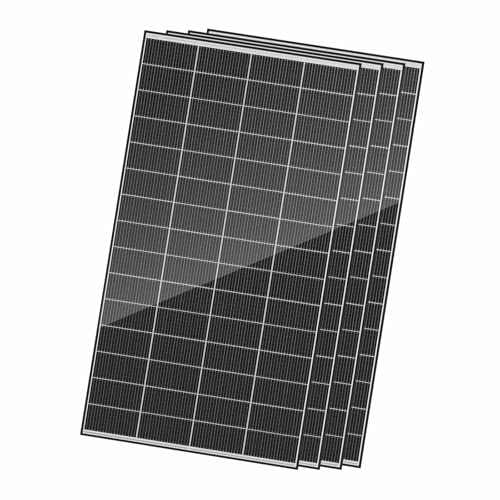
The Renogy 320 Watt Solar Panels 4PCS package delivers an intermediate power footprint for builders who need meaningful generation without consuming an entire large roof. Each module in this pack utilizes an 18-busbar N-type monocrystalline silicon design with a stated 25% cell efficiency. Renogy highlights that this N-type architecture reduces hot spot vulnerability in high-temperature environments, aided by an upper thermal rating of 185 degrees Fahrenheit. Listed specifications indicate an amperage capacity of 8.92 amps and a maximum voltage rating of 24 volts, with IP68 solar connectors factory-installed on the back of each panel.
According to listing documentation, each panel yields up to 1600 watt-hours of electricity per day under optimal sunlight conditions, delivering 20 watts higher efficiency than legacy 300-watt designs. The panels are electroluminescence certified to verify the absence of microcracks that could degrade output over time. Structurally, the modules feature an anti-corrosion coated aluminum frame with multi-layered sheet lamination designed to shield internal cells against physical distortion. The entire four-piece shipment is listed at 142 pounds, with each panel measuring 64.3 inches long by 34.7 inches wide by 1.38 inches deep. Note that while the listing title specifies 320-watt panels, the product specification table contains an entry listing maximum power as 100 watts, representing an apparent typographical error in the Amazon technical data field.
This four-module package suits mid-sized overland camper vans, enclosed creator mobile studios, and off-grid shed workshops running mid-range lithium battery banks. It provides enough cumulative surface area to sustain daily laptop editing sessions, lighting, and camera battery charging arrays. Where roof space is severely constrained, shoppers should step down to a two-panel bundle, whereas heavy remote production setups with multiple workstations will need the greater surface area of the six-panel array.
02
Renogy Solar Panels 640 Watt N-Type
The Renogy Solar Panels 640 Watt N-Type bundle packages two 320-watt modules to create a compact 640-watt array. Each panel incorporates 18-busbar N-type monocrystalline cells with a rated 25% cell efficiency and an upper operating temperature threshold of 185 degrees Fahrenheit. The manufacturer documents an operating amperage capacity of 8.46 amps at a maximum voltage rating of 24 volts direct current. The specification table notes a 32-cell count along with rigid, non-folding construction.
Daily generation across both modules is rated at up to 3200 watt-hours combined, providing steady top-up capability for 12-volt and 24-volt battery banks. Like the single-panel listings, these panels feature electroluminescence verification for microcrack prevention and IP68-rated junction and connector weatherproofing. The total package weight is specified at 90.5 pounds, with individual dimensions of 64.37 inches long by 34.65 inches wide and 1.38 inches thick. The manufacturer includes a specific application instruction noting that the modules must be mounted in locations free of shading year-round to ensure unobstructed light access.
This dual-panel package fits van conversions, teardrop trailers, and small marine craft where roof real estate only allows two large-format modules. It offers a practical daily power supply for mobile vloggers running mirrorless camera chargers, drone battery docks, and a single editing laptop. If your workflow includes running portable air conditioning, induction cooktops, or expansive lighting rigs, this two-panel setup quickly gives way to the four-pack or six-pack configurations.
03
Renogy Solar Panels 2PCS 320 Watt
The Renogy Solar Panels 2PCS 320 Watt bundle is another dual-module configuration focused on durability in challenging environments. The listing highlights an advanced 18-busbar N-type cell layout that achieves 25% conversion efficiency, providing a stated 6.7% improvement in power over legacy 300-watt panels. The twin panels are rated to generate up to 3200 watt-hours daily when exposed to standard peak sun hours. This listing explicitly emphasizes Renogy’s 10-year materials and workmanship service coverage alongside an output performance guarantee, a detail not spelled out in all alternative pack listings.
Physical protection relies on multi-layer encapsulation paired with reinforced laminations that shield the photovoltaic cells from physical impact, deformation, and harsh environmental wear. The listings cite slight dimension differences compared to other entries, stating 65 inches in length, 35 inches in width, and 1.4 inches in thickness, with an aggregate package weight of 66 pounds. As with other Renogy rigid modules, the corrosion-resistant aluminum frame includes pre-drilled mounting holes compatible with Z-brackets, corner brackets, pole mounts, and tilt mounts. While significantly larger than compact renogy solar panels 100 watt units, these full-sized panels maximize power output per square inch of available surface.
This bundle is targeted directly at solo creators, weekend campers, and budget-conscious mobile editors building their first permanent 24-volt solar charging array. The included 10-year warranty coverage provides added peace of mind for road-going rigs subjected to constant vibration. Users planning to power stationary off-grid basecamp structures or continuous high-wattage field gear will outgrow this setup and should look toward Renogy’s larger multi-pack offerings.
04
Renogy 320 Watt Solar Panels 6PCS
Scaling up to substantial generation capacity, the Renogy 320 Watt Solar Panels 6PCS package delivers six matched 320-watt rigid modules. Built with the same 18-busbar N-type architecture, the array provides 25% cell efficiency and improved thermal stability compared to conventional P-type silicon. The electrical parameters listed include an amperage capacity of 8.92 amps, a maximum voltage of 24 volts, and standard solar connectors. The listing specifies the item weight at 35 pounds, which reflects the weight of an individual module rather than the full six-panel freight weight.
The listing outlines a production rating of up to 1600 watt-hours per day per panel, giving a six-panel array the theoretical potential to generate up to 9600 watt-hours daily under ideal sunlight. Each module is EL certified to ensure defect-free silicon layers, and the multi-layered encapsulation provides IP68 ingress protection against dust and moisture intrusion. Panel dimensions remain standard across the series at 64.3 inches long, 34.7 inches wide, and 1.38 inches thick, with pre-drilled holes ready for roof racks or stationary ground mount framing.
This package suits high-draw mobile production trailers, converted school buses, and remote field research cabins that support multi-monitor editing stations, streaming gear, and refrigeration. It bridges the gap between mid-tier recreational arrays and full off-grid residential setups. If physical roof space cannot accommodate six 64-inch panels, users must step down to the four-pack, while larger commercial projects can expand directly to the eight-panel bundle.
05
Renogy Solar Panels 1920 Watt N-Type
The Renogy Solar Panels 1920 Watt N-Type system is an engineered six-panel bundle carrying the specific manufacturer model number RSP320DC-BKx6-DSV-03. With an aggregate rating of 1920 watts, the system utilizes 18BB N-type monocrystalline cells with 25% cell efficiency. Electrical ratings list an amperage capacity of 8.43 amps and an output voltage of 24 volts direct current, along with an upper temperature tolerance of 185 degrees Fahrenheit for high-heat desert or rooftop environments.
A notable distinction in this listing is the explicit confirmation of included components, which specifies six 320W solar panels, solar connectors, and an instructional manual. The panels share the standard external dimensions of 64.3 inches by 34.7 inches by 1.38 inches, featuring IP68 weatherproof construction and anti-corrosion coated aluminum framing. The listing bullets repeat a daily generation figure of 3200 watt-hours, though this metric appears carried over from dual-panel text rather than reflecting the six-panel array’s true cumulative potential.
This 1920-watt bundle is aimed at remote homesteaders, off-grid studio workshops, and large mobile production rigs that require a verified, single-sku six-panel order with connectors included in the box. It gives commercial creators the headroom needed to run heavy loads like studio lighting, editing servers, and power tool chargers. However, for builders with smaller vehicle roofs or those seeking to expand beyond six panels in a single delivery, the eight-panel configuration provides more raw capacity.
06
Renogy 320 Watt Solar Panels 8PCS
Representing the maximum surface area and total generation capacity in this range, the Renogy 320 Watt Solar Panels 8PCS bundle includes eight 320-watt N-type panels. Like the other entries, these modules feature 18-busbar cell layouts designed to minimize resistance and curtail hot spot development under intense sunlight. Each panel is built with multi-layered sheet lamination, an anti-corrosion aluminum frame, and IP68-rated solar connectors, offering resistance to moisture and mechanical stress.
Listing data reveals several unique entries for this bundle: while the maximum voltage is stated at 24 volts with an amperage capacity of 8.92 amps, the output voltage field lists 12 volts direct current, and the cell count is marked as 18. These conflicting field entries underscore the importance of verifying your charge controller’s input parameters against physical panel nameplates upon arrival. Each panel measures 64.3 inches long by 34.7 inches wide, with the listing citing an item weight of 35 pounds per individual unit. Individual module output is rated at up to 1600 watt-hours daily, yielding a massive cumulative theoretical output across all eight panels.
This eight-panel package is designed for permanent off-grid tiny homes, remote creative cabins, and extra-large commercial trailers with extensive roof space. It supports sustained, heavy energy consumption including workstation computers, audio monitoring gear, satellite internet uplinks, and auxiliary appliances. It is entirely excessive for compact camper vans or hobbyists with modest 12-volt battery setups, where a two-panel or four-panel package is far more manageable to transport and mount.
Matching a Model to Your Setup
- Compact Vanlife Creators: The Renogy Solar Panels 640 Watt N-Type provides a two-panel footprint that fits between standard roof vents while generating enough power for laptop charging and a 12V cooler.
- Solo Mobile Videographers: The Renogy Solar Panels 2PCS 320 Watt bundle offers dual-module charging backed by an explicitly stated 10-year workmanship guarantee, ideal for overland rigs subject to constant road vibration.
- Mid-Sized Studio Campers: The Renogy 320 Watt Solar Panels 4PCS array balances substantial daily watt-hour output with roof space, powering editing gear, camera banks, and interior ventilation fans.
- Field Production Basecamps: The Renogy Solar Panels 1920 Watt N-Type bundle provides a verified six-panel collection with included solar connectors for off-grid editing trailers running multiple workstations.
- Permanent Remote Cabins: The Renogy 320 Watt Solar Panels 6PCS package gives off-grid hobbyists high-efficiency charging to keep large battery banks topped off through overcast conditions.
- Heavy Industrial or Off-Grid Tiny Homes: The Renogy 320 Watt Solar Panels 8PCS package maximizes generation across eight modules for setups with massive roof space and heavy, sustained electrical loads.
Before You Buy
While Renogy packages these 320-watt N-type modules in multi-panel bundles, the product listings do not include essential balance-of-system components. Mounting hardware such as Z-brackets, corner brackets, and tilt mounts must be purchased separately, as none of the multi-packs include brackets in the box. Furthermore, the listings do not bundle charge controllers, inline fuses, circuit breakers, or extension cabling required to bridge the distance between your roof array and battery bank. You will need to calculate your system’s aggregate voltage and amperage to select an appropriate MPPT charge controller that can safely handle the input from these 24-volt panels.
Shoppers should also pay close attention to listing specification discrepancies across these multi-packs. Several listings mix individual module specifications with total package values; for instance, some six-panel and eight-panel listings display an item weight of 35 pounds, which reflects a single panel rather than the total freight weight of the entire bundle. Additionally, listings contain minor conflicting data entries regarding output voltage and cell counts. Verify the physical specification label on the rear of each module before wiring your series or parallel strings into your solar power system.
FAQ
How do N-type solar cells differ from standard solar panels?
N-type monocrystalline cells are doped with phosphorus rather than boron, which prevents light-induced degradation and significantly curtails the formation of hot spots. Renogy pairs this N-type architecture with an 18-busbar layout that shortens current pathways and improves thermal tolerance up to 185 degrees Fahrenheit, allowing the panel to achieve a listed 25% cell efficiency.
Can Renogy 320W solar panels charge a 12V battery system?
Yes, but you must use an MPPT charge controller rather than a standard PWM controller. Because these panels feature an operating output around 24 volts, an MPPT controller is required to step down the higher panel voltage to the appropriate charging voltage for a 12-volt battery bank while converting excess voltage into charging current.
What mounting hardware works with Renogy 320 watt solar panels?
All Renogy 320-watt rigid solar panels feature pre-drilled holes on the reverse side of the aluminum frame. According to the manufacturer listings, these holes are compatible with Renogy Z-brackets, corner brackets, pole mounts, ground mounts, and adjustable tilt mounts. The mounting brackets themselves are not included in the panel packages and must be acquired separately.
How much daily energy can a Renogy 320W solar panel produce?
The product listings state that each 320-watt panel can generate up to 1600 watt-hours of electricity per day under optimal sun conditions. Actual yields will vary based on geographic location, sun angle, seasonal variation, panel tilt, and shading across the module surface.
Are mounting brackets and charge controllers included with these multi-packs?
No. The product listings contain only the solar panels and, in select bundles like the 1920-watt package, solar connectors and an instruction manual. Charge controllers, mounting hardware, branch connectors, and heavy-gauge system wiring must be sourced separately to complete the installation.


