As Amazon Associates, we earn from qualifying purchases. This means we may receive a small commission at no extra cost to you if you click through and make a purchase.
Content creators, audio engineers, video editors, and livestreamers face a constant battle between hardware heat and microphone noise. Powerful editing workstations, multi-monitor arrays, studio lighting, and audio interfaces generate substantial thermal loads in compact production spaces. Traditional air conditioning units often solve the heat issue at the expense of audio clarity, introducing low-frequency mechanical rumble, compressor clicks, and rushing airflow that easily breach the noise floor of sensitive condenser microphones. When selecting a cooling solution, creators must choose between portable floor units that offer installation versatility and window-mounted systems that maximize acoustic separation. Identifying a genuine midea ultra quiet air conditioner requires evaluating not just raw cooling capacity, but how compressor design, chassis geometry, and airflow engineering impact the ambient decibel floor of your workspace.
Midea organizes its quiet cooling lineup into two primary architectural formats: U-shaped inverter window air conditioners and dual-hose inverter portable units, alongside traditional entry-level portable options. The U-shaped window design physically isolates the mechanical compressor outside the window pane, allowing the window sash to act as an acoustic barrier that drops noise levels to whisper-quiet thresholds. Conversely, the Midea Duo portable series integrates variable-speed inverter rotary compressors and an innovative hose-in-hose airflow structure into a mobile footprint, eliminating negative room pressure while maintaining controlled sound levels. Understanding this midea air conditioner comparison helps identify which architecture aligns with your window dimensions, room volume, and acoustic tolerance.
This guide by the numbers
4.8/5
Best rated model
Highest buyer average in this line-up, as left by Amazon shoppers
6
Models on file
Models in this guide that have a stored product record
1
Brand involved
Distinct brand names on the product records used here
Figures come from the stored Amazon listing data for the products in this article. Ratings are buyer averages, not scores given by this site.
Midea Air Conditioners Lineup at a Glance
| Model | Cooling Capacity | Sound Level | Form Factor |
|---|---|---|---|
| Midea Duo 14,000 BTU Portable Air | 14,000 BTU (12,000 BTU SACC) | 42 dB | Inverter Portable |
| Midea Duo 12,000 BTU Portable Air | 12,000 BTU (10,000 BTU SACC) | 42 dB | Inverter Portable |
| Midea 10,000 BTU U-Shaped Smart Inverter | 10,000 BTU | 32 dB | Inverter Window |
| Midea 6,000 BTU U Shaped Window | 6,000 BTU | 32 dB | Inverter Window |
| Midea 7,800 BTU Window Air Conditioner | 7,800 BTU | 39 dB | Inverter Window |
| Midea 8,500 BTU ASHRAE Portable Air | 8,500 BTU (5,000 BTU SACC) | 52.6 dB | Non-Inverter Portable |
The Models in Detail
01
Midea Duo 14,000 BTU Portable Air

Midea Duo 14,000 BTU Portable Air
Best for: Large studios needing high-capacity portable cooling
Pros
- 42 dB quiet operation
- Dual hose-in-hose design
- Variable-speed inverter
Cons
- Higher sound floor than window units
- Requires floor space
The Midea Duo 14,000 BTU Portable Air conditioner is engineered for large creative spaces, control rooms, and open studio apartments up to 550 square feet. Generating 14,000 BTU of cooling power (rated at 12,000 BTU under SACC standards), this unit features Midea’s dual hose-in-hose design. Traditional single-hose portable air conditioners pull conditioned air out of the room to exhaust heat outdoors, creating negative air pressure that draws warm, humid air in through door cracks and exterior gaps. The Duo configuration pulls fresh outdoor air through an outer sleeve while exhausting hot air through the inner core, maintaining balanced internal air pressure and accelerating cooling speeds up to two times faster than standard designs.
Acoustically, the unit is rated as low as 42 dB during cooling operation. It achieves this library-quiet baseline by utilizing a variable-speed rotary scroll inverter compressor that ramps power up and down gradually rather than cycling violently on and off. The unit projects air up to 26 feet using an optimized air duct system paired with a 102-degree dynamic swing louver to circulate air across complex studio desk layouts. It runs on standard 115-volt corded electric power, utilizes R 410A refrigerant, and features an integrated Air Fresh and dust filter. Smart connectivity is enabled through the SmartHome app for iOS and Android, allowing automated scheduling and voice operation via Amazon Alexa or Google Assistant.
This model is built for creators operating heat-intensive computer rigs, rendering arrays, and multi-light setups in medium-to-large spaces where window modifications are restricted by building rules. However, for smaller production offices under 450 square feet, the 14,000 BTU capacity may exceed requirements, making the 12,000 BTU Duo a more proportional selection.
02
Midea Duo 12,000 BTU Portable Air
Best for: Mid-sized editing suites requiring portable cooling
Pros
- 42 dB quiet operation
- Balanced dual-hose system
- Smart Wi-Fi control
Cons
- Not as quiet as U-shaped units
- Hose assembly limits placement
The Midea Duo 12,000 BTU Portable Air conditioner brings the engineering advantages of the Duo platform into a footprint tailored for spaces up to 450 square feet. Delivering 12,000 BTU (10,000 BTU SACC), it utilizes the same proprietary hose-in-hose assembly to isolate outdoor air exchange from indoor air volume. This closed-loop circulation stops warm air seepage, enabling faster room cooling while preserving indoor climate stability. If you are researching mid-sized mobile units, our detailed breakdown of the midea portable ac 12000 btu category explores how inverter-driven airflow systems manage studio equipment heat.
At a sound rating of 42 dB, the Duo 12,000 BTU model produces a steady, unobtrusive acoustic profile. The rotary scroll inverter compressor avoids the abrupt acoustic spikes characteristic of conventional compressors, which is critical when recording continuous audio tracks or hosting live streams. The internal blower projects air up to 26 feet, supported by the 102-degree dynamic swing louver system. The unit is housed in a black residential chassis, features washable dust filtration, operates on 115 volts, and uses R 410A refrigerant. Full integration with the SmartHome app and voice control platforms allows hands-free temperature adjustments from an audio console or camera setup.
This model suits video editors, podcasters, and bedroom musicians who require a portable form factor capable of managing substantial heat without dominating the room’s sound floor. It yields priority to the 14,000 BTU Duo for spaces exceeding 450 square feet, or to Midea’s U-shaped window models if you need a sub-40 dB noise floor for ultra-sensitive vocal tracking.
03
Midea 10,000 BTU U-Shaped Smart Inverter
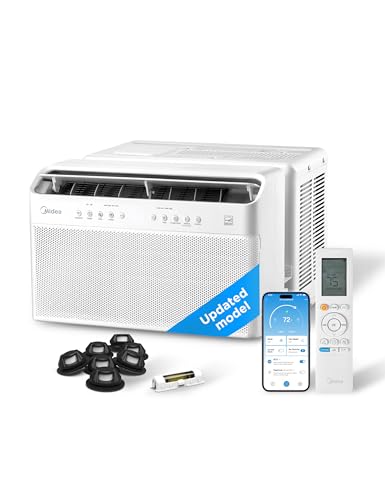
Midea 10,000 BTU U-Shaped Smart Inverter
Best for: Acoustically sensitive recording studios up to 450 sq ft
Pros
- Ultra-quiet 32 dBA rating
- Window sash noise barrier
- Over 35% energy savings
Cons
- Requires hung window installation
- Not for casement windows
The Midea 10,000 BTU U-Shaped Smart Inverter window air conditioner represents a radical departure from traditional window units, making it widely regarded as a quietest midea ac for studio environments. Rated at 10,000 BTU to cool spaces up to 450 square feet, its signature U-shaped channel allows the window sash to close directly inside the unit’s body. By positioning the rotary vane inverter compressor on the exterior side of the window glass and the blower fan on the interior side, the building’s window acts as a physical acoustic dampener. This design results in an ultra-low operational sound level of 32 dBA, representing a tenfold noise reduction compared to standard window units.
Beyond acoustic isolation, the unit delivers more than 35% energy savings compared to federal baselines, earning Energy Star certification. The electrical profile requires 890 watts with a rated cooling amperage of 9.97 amps on 115-volt power, constructed with copper core components and utilizing eco-conscious R-32 refrigerant. The unit includes a multi-function remote control, dehumidifier mode, fast cooling capabilities, and a washable dust filter. The U-shaped architecture preserves window functionality, allowing you to open the window for fresh air without removing the air conditioner, while an integrated anti-theft mechanism locks the sash when closed for security.
This model is the premier choice for tracking rooms, voiceover booths, and critical listening studios where microphone gain structures amplify room noise. Installation requires single-hung or double-hung windows between 22 and 36 inches wide with a minimum opening height of 13.75 inches using the included quick-snap bracket. For rooms under 250 square feet, this model yields to the 6,000 BTU variant to avoid rapid short-cycling.
04
Midea 6,000 BTU U Shaped Window

Midea 6,000 BTU U Shaped Window
Best for: Small vocal booths and compact audio workspaces
Pros
- Whisper-quiet 32 dB operation
- Over 37% energy savings
- Low 625-watt power draw
Cons
- Limited to 250 sq ft
- Incompatible with casement windows
The Midea 6,000 BTU U Shaped Window air conditioner packages Midea’s acoustic isolation architecture into a compact capacity designed for spaces up to 250 square feet. Like its higher-capacity sibling, this unit relies on a physical U-shaped split chassis that places the rotary scroll inverter compressor outside the window envelope. With the window glass closed inside the center channel, the unit registers an ultra-quiet 32 dB noise level. This enables creators working in small spaces to maintain comfortable temperatures without having to shut down climate control during recording passes.
Power consumption is exceptionally low at 625 watts on a 115-volt line, delivering over 37% energy savings compared to conventional window models and securing Energy Star certification. The system operates with R-32 refrigerant and includes fast cooling modes, an infrared remote control, and full compatibility with the SmartHome app, Amazon Alexa, and Google Assistant. The installation process uses a robust quick-snap support bracket designed for single-hung or double-hung windows measuring 22 to 36 inches wide, requiring a minimum vertical opening of 13.75 inches. The anti-theft locking mechanism provides structural security while allowing the window to open freely for outdoor ventilation.
This unit is specifically tailored for vocal isolation booths, compact streaming nooks, and dedicated voiceover spaces where thermal load is moderate but acoustic quietness is paramount. Creators managing larger rooms or intense multi-person studio sessions will find the 6,000 BTU capacity insufficient and should step up to the 10,000 BTU U-shaped model.
05
Midea 7,800 BTU Window Air Conditioner

Midea 7,800 BTU Window Air Conditioner
Best for: Workspaces needing balanced cooling and 39 dB sound
Pros
- 39 dBA low noise level
- Variable-speed inverter
- Energy Star certified
Cons
- Requires 19.6-inch window height
- Not casement window compatible
The Midea 7,800 BTU Window Air Conditioner provides an intermediate cooling capacity for rooms up to 340 square feet, utilizing an inverter-driven mechanism in a streamlined window chassis. Operating at a sound rating as low as 39 dBA, this unit maintains low acoustic interference suitable for video conferencing, podcast recording, and general media production. It features a variable-speed inverter system that delivers a Combined Energy Efficiency Ratio (CEER) of 15.1, earning Energy Star certification while drawing 605 watts on 115 volts. Creators exploring traditional window footprints can reference our analysis of the midea window ac 8000 btu class to assess standard installation requirements.
The unit features comprehensive electronic controls, an LED display, a 24-hour timer, an ECO energy-saver mode, and automated louvers with a Swing button for dynamic vertical airflow distribution. It offers four operating modes—Auto, Cool, Dry, and Fan—paired with three fan speeds (Auto, High, Medium, Low) and integrated dehumidifier functionality. The chassis measures 21.97 inches deep, 19.17 inches wide, and 13.46 inches high, weighing 52.6 pounds. Installation requires single-hung or double-hung windows with widths from 23 to 36 inches and a minimum vertical opening height of 19.6 inches using the included quick-snap bracket. The listing notes that it is not compatible with casement windows.
This model is an effective solution for multi-use home studios and edit suites requiring more cooling than a 6,000 BTU unit without the physical overhang of a 10,000 BTU unit. However, if your microphone setup demands an absolute minimum noise floor below 35 dB, the U-shaped series remains the superior acoustic option.
06
Midea 8,500 BTU ASHRAE Portable Air
Best for: Equipment closets and non-recording utility rooms
Pros
- 3-in-1 cooling and dehumidifying
- Tool-free window kit included
- Washable reusable filter
Cons
- 6 dB non-inverter noise
- Reciprocating compressor
The Midea 8,500 BTU ASHRAE Portable Air conditioner provides 8,500 BTU of ASHRAE cooling capacity (5,000 BTU SACC standard), designed to cool compact areas up to 150 square feet. Unlike the inverter-equipped models in Midea’s quiet lineup, this EasyCool 3-in-1 portable unit relies on a conventional reciprocating compressor. Operating at a sound level of 52.6 dB, it presents a noticeably louder acoustic profile that makes it unsuitable for active microphone recording environments, though it remains functional for non-critical workspaces.
The unit integrates three primary functions: cooling, fan circulation, and dehumidification. It comes equipped with digital controls, an LED display, a 24-hour programmable timer, and a compact remote control with batteries included. Despite its non-inverter compressor, it offers modern smart capabilities, connecting to the SmartHome app for remote management and integrating with Amazon Alexa and Google Assistant. Physical setup involves rolling the unit on integrated casters and attaching the included 5-foot exhaust hose to an adjustable window bracket designed to fit openings from 26.5 to 48 inches without specialized tools. Filtration is managed by a removable, washable, and reusable air filter that requires weekly cleaning, while internal mechanics utilize a durable copper core.
This portable model is best suited for equipment storage rooms, server closets, or auxiliary editing desks where keeping hardware cool takes precedence over recording silence. Whenever audio fidelity and microphone isolation are required, this model gives way to the Midea Duo inverter portable AC series or the U-shaped window units.
Matching a Model to Your Setup
- Acoustically critical vocal booths and podcast rooms: Choose the Midea 6,000 BTU U Shaped Window unit for its whisper-quiet 32 dB operation, physical window sound barrier, and compact 625-watt power consumption.
- Mid-sized video editing suites with double-hung windows: Deploy the Midea 10,000 BTU U-Shaped Smart Inverter to cool up to 450 square feet at 32 dB, ensuring heavy GPU rendering heat is extracted without disrupting monitor audio; studios needing seasonal flexibility can review midea window ac with heat configurations.
- Studios with strict HOA or window alteration limits: Install the Midea Duo 14,000 BTU Portable Air or Duo 12,000 BTU model to benefit from the 42 dB inverter rotary scroll compressor and balanced dual-hose airflow without mounting hardware outside the sill.
- General production offices requiring low fan hum: Select the Midea 7,800 BTU Window Air Conditioner, which maintains a 39 dB sound floor and high CEER 15.1 efficiency across spaces up to 340 square feet.
- Dedicated gear closets and server racks: Utilize the Midea 8,500 BTU ASHRAE Portable Air unit for straightforward 3-in-1 cooling and dehumidification in non-recording spaces up to 150 square feet where a 52.6 dB floor is acceptable.
Before You Buy
Before purchasing, examine your specific window frame architecture against the installation requirements stated in the listings. The Midea U-shaped window air conditioners require single-hung or double-hung windows with a width between 22 and 36 inches and a minimum clearance height of 13.75 inches, while the 7,800 BTU window unit requires a higher 19.6-inch opening. None of the window units in this lineup support casement or sliding windows. Furthermore, the listings do not specify the acoustic density or noise-reduction ratings (STC) of the included foam side panels. Creators working in urban environments with substantial street noise may need to reinforce the side panel gaps with third-party dense acoustic foam to prevent external sound bleed.
Electrical and acoustic duty cycles also warrant consideration. While Midea publishes minimum decibel ratings—such as 32 dBA for the U-shaped units and 42 dB for the Duo series—the listings do not specify maximum decibel levels when the units operate at peak fan speed or during maximum cooling ramp-ups. Additionally, while the listings provide wattage for models like the 10,000 BTU U-shaped unit (890W) and the 6,000 BTU U-shaped unit (625W), they do not specify standby power draw. Creators operating in home studios with shared 15-amp circuit breakers should calculate the cumulative electrical draw of their recording monitors, computers, and lighting gear before connecting these units.
FAQ
How do Midea U-shaped window air conditioners achieve such low decibel ratings?
Midea U-shaped window air conditioners achieve a 32 dBA noise rating by physically isolating the noisy components outside the room. The U-shaped chassis design allows the window sash to slide down into a central groove between the indoor air handler and the outdoor rotary compressor. The window glass acts as an acoustic barrier, blocking compressor vibration and mechanical noise from entering the indoor studio environment.
What makes the Midea Duo portable series quieter than traditional portable air conditioners?
The Midea Duo portable series operates at 42 dB, significantly quieter than traditional units, by utilizing variable-speed inverter technology with a rotary scroll compressor. Unlike conventional portable units that cycle on and off at full volume, the inverter compressor adjusts speed dynamically. Additionally, its dual hose-in-hose design balances indoor and outdoor air exchange, preventing negative room pressure and reducing turbulent airflow noise.
Can the Midea 8,500 BTU ASHRAE portable unit be used in a recording room?
The Midea 8,500 BTU ASHRAE portable unit operates at 52.6 dB and uses a standard reciprocating compressor without inverter technology. This sound level produces a noticeable hum and airflow noise that will readily register on sensitive studio microphones. It is best reserved for equipment rooms, editing bays where live recording is not occurring, or utility areas.
Do Midea ultra-quiet air conditioners support hands-free control?
Yes, the Midea Duo portable models, the U-shaped inverter window units, and the 7,800 BTU window unit all feature Wi-Fi connectivity. They can be controlled remotely through the SmartHome app on iOS and Android or hands-free via voice commands using Amazon Alexa and Google Assistant devices, allowing creators to adjust settings without leaving their workstation.
Which Midea air conditioner is best for a small vocal booth?
The Midea 6,000 BTU U Shaped Window air conditioner is ideal for compact vocal booths and small studios up to 250 square feet. Its 32 dB sound floor prevents low-frequency noise interference, its 625-watt power consumption is gentle on studio electrical circuits, and its U-shaped design isolates the compressor outside the window frame.