
As Amazon Associates, we earn from qualifying purchases. This means we may receive a small commission at no extra cost to you if you click through and make a purchase.
Thermal control is a persistent challenge for creators, livestreamers, and home-studio engineers who run power-hungry workstation towers, professional lighting grids, and audio interfaces in confined rooms. Traditional room cooling hardware introduces high ambient noise levels that bleed into sensitive condenser microphones, forcing audio editors to perform heavy spectral de-noising in post-production. Investing in a midea 10000 btu window air conditioner provides the cooling volume required to offset significant studio heat loads, but choosing the proper model requires evaluating compressor engineering, room isolation, and mounting requirements. Selecting the wrong platform means either suffering through sweltering recording sessions or switching the climate system off entirely every time you hit record.
Across its catalog, Midea organizes cooling hardware into distinct operational tiers based on compressor behavior and chassis design. Its flagship split-chassis units isolate mechanical vibrations outside the window sill, while standard inverter models leverage variable-speed motors to stabilize ambient conditions without abrupt cycling spikes. In contrast, portable configurations offer flexible floor positioning for spaces with unusual window openings. If you are examining a midea window ac for a production environment, understanding how chassis construction and compressor type alter your acoustic noise floor is the primary step in deciding which midea window air conditioner to buy.
This guide by the numbers
8.4/10
Best rated model
Our highest score in this line-up
4
Models on file
Models in this guide that have a stored product record
1
Brand involved
Distinct brand names on the product records used here
Prices and specifications come from the stored Amazon listing data for the products in this article. Scores are out of 10, based on listed specifications and buyer feedback.
Midea Window Air Conditioners Lineup at a Glance
| Model | Cooling Capacity & Coverage | Sound Rating | Compressor & Inverter Type | Key Hardware Features |
|---|---|---|---|---|
| Midea 10,000 BTU U Shaped Window | 10,000 BTU (Up to 450 sq. ft.) | 32 dBA | Inverter Rotary (Has Inverter) | U-shape chassis, quick-snap bracket, R-32 refrigerant, 890W |
| Midea 10,000 BTU U-Shaped Smart Inverter | 10,000 BTU (Up to 450 sq. ft.) | 32 dBA | Rotary Vane (Has Inverter) | Copper core, dust filter, dehumidifier, 890W, 9.97A |
| Midea 7,800 BTU Window Air Conditioner | 7,800 BTU (Up to 340 sq. ft.) | 39 dBA | Variable-Speed (Has Inverter) | Swing louvers, 15.1 CEER, 605W, 4 modes, LED display |
| Midea 10,000 BTU ASHRAE Portable Air | 10,000 BTU ASHRAE / 7,100 BTU SACC (Up to 300 sq. ft.) | 52.8 dBA | Reciprocating (No Inverter) | Caster wheels, 5ft exhaust hose, washable filter, 3-in-1 modes |
The Models in Detail
01
Midea 10,000 BTU U Shaped Window

Midea 10,000 BTU ASHRAE Portable Air
Best for: Rental studios lacking exterior bracket access
Pros
- Mobile roll-away caster design
- Tool-free window bracket kit included
- Washable reusable air filter
Cons
- Higher 52.8 dBA operational noise
- Non-inverter reciprocating compressor
Midea 10,000 BTU U-Shaped Smart Inverter
Best for: Humid workstations housing sensitive electronics
Pros
- Durable copper core construction
- Built-in dehumidifier and dust filter
- Variable-speed rotary vane compressor
Cons
- High 9.97-amp cooling draw
- Requires compatible double-hung frames

Midea 10,000 BTU U Shaped Window
Best for: Acoustic-critical live streaming and voiceover studios
Pros
- Ultra-quiet 32 dBA operation
- Over 37 percent energy savings
- Preserves window opening functionality
Cons
- Requires specific sash window dimensions
- Chassis weight requires bracket assembly
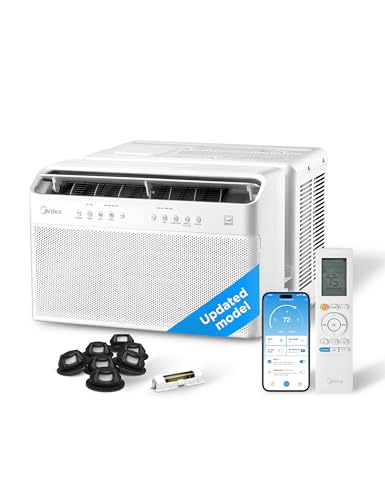
The Midea 10,000 BTU U Shaped Window is engineered specifically to address acoustic transfer between the mechanical compressor and the interior listening space. The listing specifies a thermal capacity of 10,000 British thermal units, capable of cooling spaces up to 450 square feet using R-32 refrigerant. Operating on a standard 115-volt corded electric connection with an 890-watt draw, this residential unit incorporates an inverter rotary compressor. The standout design element is its physical U-shaped silhouette, which allows the window sash to slide down between the outdoor heat-exchange assembly and the indoor blower housing. According to the manufacturer, this physical barrier shields the room from outdoor mechanical rattle, enabling operating volumes as low as 32 dBA—a specification listed as nine times quieter than traditional cooling units.
For creators managing open microphones, this sound barrier makes it a top contender for the quietest midea window ac for home studio environments. The listing highlights advanced DC inverter technology that yields over 37 percent energy savings compared to traditional units, earning it Energy Star certification. In terms of workflow integration, the unit is Wi-Fi enabled and connects to the SmartHome app on iOS and Android, allowing automated climate scheduling around streaming sessions. Voice control is supported via Amazon Alexa and Google Assistant. Physical installation utilizes an included quick-snap bracket for single-hung or double-hung windows measuring 22 to 36 inches wide, requiring a minimal window opening height of 13.75 inches. When closed, an integrated anti-theft mechanism locks the sash in place, maintaining physical security while permitting the window to be opened for fresh air when cooling is inactive.
02
Midea 10,000 BTU U-Shaped Smart Inverter
In a direct midea 10000 btu window air conditioner comparison, the Midea 10,000 BTU U-Shaped Smart Inverter presents a closely matched alternative that highlights specific internal component materials. Built with a copper core and a rotary vane compressor, this model also delivers 10,000 British thermal units of cooling power for rooms up to 450 square feet. It matches the 32 dBA minimum operating sound profile, described in its listing as ten times quieter than conventional designs. Rated cooling specifications list an electrical consumption of 890 watts and 9.97 AHAM rated cooling amps. Creators balancing thermal capacity in medium-sized workspaces might also evaluate a midea window ac 8000 btu platform, but this 10,000 BTU model provides extra headroom for cooling setups packed with rendering workstations and studio monitors.
Beyond baseline thermal performance, the listing specifies dedicated air management functions, including an integrated dehumidifier mode, an internal dust filter, and fast cooling capabilities. These attributes are beneficial for content creators who need to protect sensitive electronics, condenser microphone capsules, and camera lenses from studio humidity. Smart control is executed via the SmartHome mobile application alongside voice commands through Alexa or Google Assistant. The hardware package includes a remote control and requires identical window geometry to its sister unit: a single-hung or double-hung opening between 22 and 36 inches in width and at least 13.75 inches in height. The quick-snap mounting bracket supports the chassis weight, while the anti-theft mechanism secures the sliding sash within the U-channel.
03
Midea 7,800 BTU Window Air Conditioner

Midea 7,800 BTU Window Air Conditioner
Best for: Mid-sized editing rooms with tall windows
Pros
- Efficient 15.1 CEER energy rating
- Motorized swing louvers direct airflow
- Quiet 39 dBA minimum noise
Cons
- Requires 19.6-inch minimal opening height
- Incompatible with casement windows
Targeted at mid-sized vocal isolation booths and compact editing suites up to 340 square feet, the Midea 7,800 BTU Window Air Conditioner provides variable-speed inverter operation in a scaled chassis. This unit produces 7,800 British thermal units of cooling capacity while consuming 605 watts on a 115-volt line. It carries an Energy Star certification with a Combined Energy Efficiency Ratio (CEER) of 15.1, meaning it draws less wall power during extended editing sessions. The acoustic profile reaches as low as 39 dBA. While not as acoustically isolating as the U-chassis models, 39 dBA remains low enough that ambient room noise can often be masked with proper microphone placement. Creators considering ultra-compact cooling options like a midea room air conditioner 5000 btu will find this 7,800 BTU model delivers stronger airflow distribution for mid-sized rooms.
Operational control is handled via an onboard LED display, a handheld remote control, or the SmartHome app with voice assistant compatibility. The unit offers four working modes (Auto, Cool, Dry, and Fan) and three manual fan speeds in addition to an Auto setting. A distinct mechanical feature on this model is the motorized Swing button, which oscillates the louvers up and down to disperse air evenly rather than blasting cold air directly toward workstation microphones. Physical dimensions measure 21.97 inches deep, 19.17 inches wide, and 13.46 inches high, with a total weight of 52.6 pounds. The included quick-snap bracket requires a window width between 23 and 36 inches, but demands a taller minimal opening height of 19.6 inches. The listing explicitly states that this model is not compatible with casement windows.
04
Midea 10,000 BTU ASHRAE Portable Air
For creators working out of rental properties, temporary production sets, or rooms with non-standard window frames, the Midea 10,000 BTU ASHRAE Portable Air offers a movable climate solution that requires no exterior window brackets. The listing rates this unit at 10,000 BTU under the ASHRAE testing standard and 7,100 BTU under the SACC standard, providing effective cooling coverage for spaces up to 300 square feet. Built with a reciprocating compressor and copper core components, this portable machine does not feature an inverter system. It operates on 115-volt power and includes 3-in-1 functionality covering air conditioning, multi-speed fan circulation, and dedicated room dehumidification. Because the entire mechanical refrigeration circuit resides inside the room, its sound level is rated at 52.8 dBA.
Physical mobility is facilitated by integrated caster wheels, allowing you to reposition the hardware away from recording desks. Installation relies on an included five-foot exhaust hose and an adjustable window slider kit that accommodates openings from 26.5 to 48 inches without extra tools. The unit features an easy-to-read LED display, a 24-hour timer, and a compact remote control with batteries supplied. Connectivity matches Midea smart ecosystem standards, enabling remote scheduling and voice commands through the SmartHome app, Alexa, and Google Assistant. Maintenance is supported by a removable, washable, and reusable air filter screen, which the manufacturer recommends rinsing weekly to protect internal components from dust, pet dander, and studio debris.
Matching a Model to Your Setup
- Live-streaming studios and voiceover booths benefit most from the Midea 10,000 BTU U Shaped Window, where the 32 dBA sound rating and physical window barrier eliminate low-frequency compressor hum from live audio feeds.
- Production spaces with high humidity and expensive electronics are best served by the Midea 10,000 BTU U-Shaped Smart Inverter, which pairs 32 dBA quiet operation with a copper core, dedicated dehumidification mode, and dust filtration.
- Compact video editing bays up to 340 square feet with vertical double-hung frames match the Midea 7,800 BTU Window Air Conditioner, providing an efficient 605-watt power draw and oscillating louvers that redirect airflow away from desk setups.
- Temporary edit rooms, leased production suites, or rooms with narrow sliding window frames require the Midea 10,000 BTU ASHRAE Portable Air, utilizing caster wheels and a tool-free slider bracket that fits openings up to 48 inches.
- Workstations running automated smart home routines can leverage any of these four models, as every unit includes SmartHome app compatibility and voice command pairing through Google Assistant and Amazon Alexa.
Before You Buy
Before purchasing any of these cooling units, verify the physical dimensions and structural limitations of your studio window. The U-shaped inverter units require a minimum vertical opening height of 13.75 inches and a width between 22 and 36 inches, whereas the 7,800 BTU unit requires a significantly taller vertical clearance of at least 19.6 inches. None of the window-mounted brackets are engineered for casement or awning-style windows, leaving the portable floor unit as the only practical alternative for hinged frames. Furthermore, the listings do not specify the exact depth or thickness of the exterior window sill ledge needed to seat the support arms, meaning shoppers with non-standard masonry or historic trim may need to evaluate their sill profiles prior to bracket installation.
Acoustic performance also requires careful contextual interpretation. While the U-shaped units advertise a quiet 32 dBA noise floor, the listings do not specify sound levels when operating at maximum fan speeds or during initial high-load pull-down cycles. Similarly, the 52.8 dBA rating on the portable air conditioner represents an indoor acoustic source that will be picked up by sensitive studio microphones, requiring vloggers to run cooling cycles between recording takes rather than during live audio capture. Lastly, although one description snippet for the 7,800 BTU unit mentions heating in passing, its operational specifications list only Auto, Cool, Dry, and Fan modes. If your creative space requires active reverse-cycle winter climate control, you should look into a specialized midea window ac with heat rather than expecting standard inverter models to provide auxiliary warmth.
FAQ
How do Midea window AC noise levels compare between U-shaped and portable units?
The U-shaped inverter units generate noise levels as low as 32 dBA, whereas the portable unit operates at 52.8 dBA. The significant difference stems from chassis architecture: U-shaped units use your closed window sash to isolate the compressor outside the room, while portable units house the compressor, fan, and condenser entirely inside the room envelope.
What is required for the Midea smart inverter AC setup and Wi-Fi pairing?
Setting up smart functionality requires downloading the SmartHome app on an iOS or Android device, connecting the air conditioner to a 2.4 GHz home Wi-Fi network, and linking your profile. Once paired, the app enables mode selection, 24-hour scheduling, temperature adjustments, and integration with Amazon Alexa or Google Assistant for voice-activated operation.
Can a Midea U inverter window AC be installed in horizontal sliding or casement windows?
No, the listings specify that the quick-snap mounting bracket and U-channel frame are designed exclusively for vertical-opening single-hung or double-hung windows measuring between 22 and 36 inches wide. They cannot be installed safely in casement or horizontal slider windows. For sliding windows, the portable unit with its adjustable slider kit is the appropriate option.
What is the difference between ASHRAE and SACC ratings on the portable unit?
The listing notes a 10,000 BTU rating under the traditional ASHRAE standard and a 7,100 BTU rating under the modern SACC standard. ASHRAE measures raw cooling output under ideal laboratory conditions, while the SACC rating accounts for the radiant heat generated by the indoor exhaust hose and cabinet during operation, representing a more realistic cooling baseline for spaces up to 300 square feet.
Does the U-shaped design prevent opening the window once installed?
No, the central benefit of the U-chassis design is that it maintains window functionality. The window sash sits inside the central channel, allowing you to slide the window up to let in fresh outside air when the cooling system is powered off. When the sash is lowered into the channel, an anti-theft mechanism engages to secure the window frame.


