As Amazon Associates, we earn from qualifying purchases. This means we may receive a small commission at no extra cost to you if you click through and make a purchase.
Managing ambient temperatures inside a creative workspace, editing bay, or home recording studio introduces distinct technical challenges that standard household cooling rarely addresses. Modern production setups packed with rendering workstations, high-draw audio amplifiers, multi-display desks, and continuous video lighting generate massive amounts of thermal load within enclosed spaces. Keeping these environments comfortable requires an effective climate control system that can quickly displace heat without introducing disruptive acoustic floor noise into sensitive microphone feeds. When choosing a setup, creators are primarily deciding whether a high-capacity unit like a dreo portable air conditioner 14000 btu model is necessary to offset substantial hardware heat, or whether a smaller compact system can handle baseline cooling in more restrained nooks. Furthermore, evaluating whether an inverter-driven compressor or a conventional single-speed rotary compressor best fits the workflow is crucial for maintaining steady room temperatures and preserving acoustic discipline during long tracking or editing sessions.
Across its current lineup, Dreo organizes its portable floor units around distinct cooling capacities, compressor behaviors, and air-exchange architectures. The catalog divides primarily between high-output platforms built for substantial heat dissipation and lighter units engineered for smaller residential rooms. In the high-output class, you will find both traditional single-hose fixed-speed platforms and advanced variable-speed inverter models utilizing dual-hose venting to separate intake and exhaust air streams. In contrast, the entry tier features lower-tonnage cooling designed for smaller square footage and reduced electrical consumption. Despite these structural differences, Dreo maintains several core technologies across the entire family, including automated drainage-free condensate evaporation for relative humidity levels under 90 percent, eco-conscious R-32 refrigerant, and integrated smart control via mobile apps and voice platforms. Understanding this product organization is essential when planning a dreo portable air conditioner comparison to determine which unit matches the physical and thermal demands of your creative room.
This guide by the numbers
4.6/5
Best rated model
Highest buyer average in this line-up, as left by Amazon shoppers
3
Models on file
Models in this guide that have a stored product record
1
Brand involved
Distinct brand names on the product records used here
Figures come from the stored Amazon listing data for the products in this article. Ratings are buyer averages, not scores given by this site.
Dreo Portable Air Conditioners Lineup at a Glance

DREO Portable Air Conditioner 318S
Best for: Small vocal booths and streaming nooks
Pros
- Low 1040-watt power demand
- Compact 8000 BTU footprint
- Quiet 45 dB noise rating
- Drain hose included for high humidity
Cons
- Insufficient for multi-GPU thermal loads
- Single-hose exhaust design

DREO Portable Air Conditioner 516S
Best for: Large creative suites and open project studios
Pros
- Powerful 14000 BTU cooling
- 16-foot extended air throw
- Self-evaporating drainage under 90% humidity
- Voice control via Siri Alexa Google
Cons
- Fixed-speed cycling compressor
- Single-hose venting creates negative pressure
| Model | Cooling Capacity | Operating Noise | Compressor and Hose Configuration | Rated Power Consumption |
|---|---|---|---|---|
| DREO Portable Air Conditioner 516S | 14000 BTU ASHRAE (10000 BTU DOE) | 45 dB | Rotary Scroll, Non-Inverter, Single-Hose | 1500 Watts |
| DREO Inverter Portable Air Conditioners,High Efficiency,14000 | 14000 BTU ASHRAE (10000 BTU DOE) | 42 dB | Inverter Technology, Dual-Hose | 1540 Watts |
| DREO Portable Air Conditioner 318S | 8000 BTU ASHRAE (5000 BTU DOE) | 45 dB | Rotary Scroll, Non-Inverter, Single-Hose | 1040 Watts |
The Models in Detail
01
DREO Portable Air Conditioner 516S
The DREO Portable Air Conditioner 516S represents the brand’s primary high-output, single-hose cooling solution designed for spaces with demanding thermal loads. Rated at 14000 BTU ASHRAE (corresponding to 10000 BTU SACC/DOE), this model relies on a packaged rotary scroll compressor operating on a standard 115-volt line with a power draw of 1500 watts. Its internal IceCool system pairs the refrigeration circuit with an integrated air circulator designed to push chilled airflow up to 16 feet away, establishing a broad reach across larger studio layouts. Operating across an adjustable thermostat range between 61°F and 86°F, it utilizes modern R-32 refrigerant to carry out heat transfer, making it a capable baseline choice for creative professionals who need substantial thermal relief in offices, living rooms, and open project studios. Creators comparing high-output standalone units may also find useful reference points in our evaluation of the midea portable ac 12000 btu system.
Functionally, the unit delivers versatile climate control through a 3-in-1 design that accommodates cooling, dehumidification, and dedicated fan-only operation, with three adjustable operational functions inside each mode. To prevent work interruptions from routine maintenance, Dreo integrates its patented drainage-free system, which leverages internal sensors, an automated algorithm, and an integrated pump to evaporate excess moisture through the exhaust hose whenever ambient humidity remains below 90 percent. As a dreo smart portable air conditioner, the 516S connects directly with Apple Siri, Amazon Alexa, and Google Home for voice-based operational adjustments. Remote monitoring through the companion Dreo smartphone app allows creators to track real-time room temperature and humidity, adjust operational settings on the fly, or configure customized sleep curves to manage nighttime studio temperatures without leaving the workstation.
In terms of acoustics, the unit incorporates Dreo’s noise isolation system, bringing working compressor and turbulence sound down to a rated 45 dB. This sound level keeps the unit well within acceptable limits for typical desk work, video editing, and daytime content planning. However, because this model operates a non-inverter compressor on a single-hose configuration, the compressor runs on a conventional cycling pattern that cuts fully in and out to maintain temperatures, which may produce noticeable ambient tone shifts during sensitive voice recording. The dreo portable air conditioner 516s is best suited for creators working in medium-to-large project studios, gear-heavy editing suites, or open workshops where high thermal output and broad air throw take priority over total acoustic invisibility. It gives way to Dreo’s inverter-driven dual-hose platform when maximum energy conservation, continuous variable-speed sound profiles, and negative-pressure prevention become necessary for critical listening spaces.
02
DREO Inverter Portable Air Conditioners,High Efficiency,14000
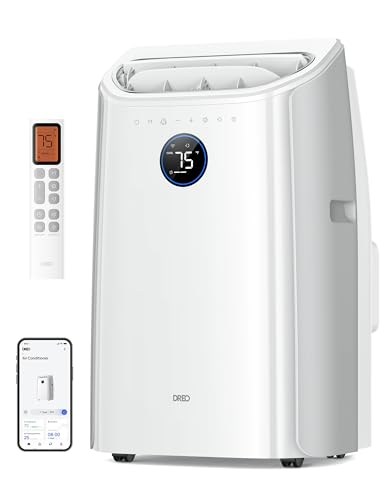
DREO Inverter Portable Air Conditioners,High Efficiency,14000
Best for: Acoustic studios and hot editing bays
Pros
- Ultra-quiet 42 dB operation
- Dual-hose negative pressure prevention
- Energy-efficient inverter technology
- Drainage-free under 90% humidity
Cons
- Higher 1540-watt power draw
- Requires dual-hose window mounting
Engineered specifically for optimal efficiency and thermal stability, the DREO Inverter Portable Air Conditioners,High Efficiency,14000 model introduces variable-capacity cooling to the 14000 BTU ASHRAE (10000 BTU DOE) performance class. Unlike traditional fixed-speed units, this model houses an inverter-driven compressor that dynamically modulates its operating frequency based on ambient demand, drawing up to 1540 watts on 115-volt corded electric power while using R-32 refrigerant. According to the listing specifications, this inverter architecture delivers up to 32 percent greater energy efficiency than traditional models while providing more stable room temperatures across spaces measuring between 200 and 300 square feet. Measuring 14.37 inches deep, 17.32 inches wide, and 28.13 inches high in a clean white finish, this floor-standing unit serves as an advanced thermal solution for spaces subjected to continuous equipment heat. Those seeking high efficiency across different mounting formats might also study window-based alternatives like the midea inverter window air conditioner with heat – quiet window ac unit and heat combo with dehumidif.
A core mechanical distinction of this model is its dual-hose venting system, which interfaces with both hung and sliding windows ranging from 20 to 53 inches. By dedicating one hose to outdoor intake and a second hose to outdoor exhaust, this dreo dual hose portable air conditioner prevents the negative room pressure common to single-hose systems, stopping warm outdoor air from seeping under studio doors or through drafts. Moisture management is handled via the brand’s patented drainage-free design, which utilizes internal sensors and an automated pump to vaporize condensed moisture directly out of the exhaust stream in conditions under 90 percent humidity, removing the need to empty condensation pans every few hours. Control options are built around simplicity and flexibility, supporting adjustments through a handheld remote, the mobile app, or hands-free Alexa voice prompts.
From an acoustic standpoint, this model is the quietest dreo portable air conditioner in the catalog, achieving an operating sound rating of just 42 dB thanks to its noise isolation enclosure and the steady modulation of its variable-speed inverter. Rather than abruptly starting and stopping the compressor with jarring acoustic clicks, the unit ramps its output smoothly, maintaining an ultra-consistent noise floor that is exceptionally friendly to live streaming, podcast tracking, and critical audio playback. The dreo inverter portable air conditioner 14000 is ideal for professional media rooms, vocal recording setups, and high-spec production suites where both powerful thermal extraction and quiet background acoustics are required. It yields to the 516S for users who prefer a simpler single-hose installation or to smaller units when cooling smaller rooms with minimal equipment heat.
03
DREO Portable Air Conditioner 318S
Designed for tighter production footprints and lower heat envelopes, the DREO Portable Air Conditioner 318S downscales cooling capacity to 8000 BTU ASHRAE (equivalent to 5000 BTU DOE/SACC). Running on a rotary scroll compressor charged with R-32 refrigerant, this single-hose packaged unit operates on 115-volt power with a significantly reduced rated wattage of 1040 watts, housed in a sleek black exterior. Its internal IceCool air delivery architecture produces a throw distance of up to 14 feet, cooling rooms down efficiently across a user-defined thermostat range of 61°F to 86°F. For solo vloggers, hobbyists working in repurposed bedrooms, or creators managing personal streaming corners, this compact unit offers an agile cooling platform that avoids drawing excessive power from shared residential circuits. Those seeking entry-level room solutions can also review lower-capacity alternatives such as the midea room air conditioner 5000 btu when outfitting very compact spaces.
Despite its reduced cooling output, the 318S shares the core feature set of Dreo’s larger platforms, offering a versatile 3-in-1 operational layout that includes cooling, dehumidifying, and fan modes, complete with three internal settings per mode. Moisture control is managed through the brand’s self-evaporating drainage-free system for relative humidity levels under 90 percent, though Dreo explicitly specifies that an included external drain hose must be attached when operating in environments where humidity surpasses 90 percent. Interaction with the unit is seamless thanks to comprehensive smart integration: users can adjust cooling parameters via the onboard touchpad, the large LED display, the included remote, or voice commands through Siri, Alexa, and Google Home. Through the Dreo mobile app, creators can also monitor environmental conditions and set personalized sleep curves to regulate room comfort during overnight editing or equipment rendering sessions.
Acoustically, the 318S integrates Dreo’s patented noise isolation system, keeping operating sounds down to 45 dB. While this sound rating matches the larger 516S, the 318S features a noticeably smaller internal motor and compressor, generating lower overall electrical draw and modest mechanical vibration. The dreo portable air conditioner 318s is the logical choice for hobbyists working in isolated vocal booths, small home offices, or secondary craft workshops where cooling demands are moderate and power conservation is critical. However, it naturally gives way to the higher-capacity dreo air conditioner 14000 btu platforms whenever workstations run multi-GPU configurations, continuous studio lighting, or when the room size exceeds the thermal reach of an 8000 BTU platform.
Matching a Model to Your Setup
- High-heat editing suites with multi-monitor rigs: The DREO Inverter Portable Air Conditioners,High Efficiency,14000 is the recommended choice because its dual-hose layout prevents negative pressure while its variable inverter steadily counters heavy continuous heat loads.
- Live streaming corners and voiceover recording booths: The DREO Inverter Portable Air Conditioners,High Efficiency,14000 provides the optimal acoustic environment, maintaining a whisper-quiet 42 dB noise floor without abrupt compressor cycling clicks.
- Medium to large open-plan creative spaces: The DREO Portable Air Conditioner 516S is built for these layouts, pairing 14000 BTU ASHRAE cooling with a powerful 16-foot air throw to circulate cool air throughout the entire room.
- Compact voice tracking nooks and small podcast spaces: The DREO Portable Air Conditioner 318S provides tailored cooling with an 8000 BTU rating, keeping physical footprint minimal without overwhelming smaller rooms.
- Home studios operating on shared electrical circuits: The DREO Portable Air Conditioner 318S is the safest fit here, drawing only 1040 watts compared to the 1500-plus watt ratings of the larger 14000 BTU models.
- Workspaces in humid regions requiring automated drainage: The DREO Portable Air Conditioner 516S and the DREO Inverter Portable Air Conditioners,High Efficiency,14000 provide worry-free self-evaporating performance under 90 percent humidity without requiring constant manual pan emptying.
Before You Buy
Before finalizing which dreo portable air conditioner to buy, it is essential to consider physical window dimensions, installation venting kits, and studio electrical capacity. The DREO Inverter Portable Air Conditioners,High Efficiency,14000 specifically notes window bracket compatibility for hung and sliding windows measuring between 20 and 53 inches, but the listings for the 516S and 318S do not specify their exact window slider kit dimensions or bracket adjustment lengths. Creators with specialized window frames, vertical casements, or sliding patio doors may need to verify fitment or prepare custom sealing materials. Furthermore, electrical demands require careful verification: both 14000 BTU models draw between 1500 and 1540 watts on standard 115V circuits. Running high-wattage air conditioning on the same branch circuit as a power-hungry rendering PC, studio monitors, or guitar tube amplifiers can easily trip a 15-amp breaker, making circuit mapping essential before installation.
Drainage behavior and unit footprint also carry important real-world implications that vary across the specifications. While all three models advertise automated drainage-free cooling in environments with relative humidity under 90 percent, operating in damp basements or during intense humid weather will eventually require continuous drainage; the listing for the 318S explicitly notes that a drain hose is included for environments above 90 percent humidity, whereas the listings for the 516S and Inverter 14000 do not specify whether an auxiliary drain hose is supplied in the package. Additionally, the listings do not specify the physical dimensions and weight for the 516S and 318S models, while the Inverter 14000 lists exact dimensions of 14.37 inches deep, 17.32 inches wide, and 28.13 inches high. Shoppers planning tight studio layouts should review broader portable chassis footprints, such as those covered in our akires portable air conditioners guide, to ensure adequate clearance around workstation desks.
FAQ
Which Dreo portable air conditioner is the quietest for audio and video work?
The DREO Inverter Portable Air Conditioners,High Efficiency,14000 is the quietest model in the lineup, operating at a rated sound level of 42 dB. In addition to its low decibel output, its inverter compressor modulates cooling capacity smoothly rather than suddenly cutting on and off, preventing jarring acoustic spikes on studio microphone recordings.
How does a dual-hose Dreo portable air conditioner outperform a single-hose model?
The dual-hose design featured on the DREO Inverter Portable Air Conditioners,High Efficiency,14000 uses separate dedicated hoses for drawing in outside air and expelling hot exhaust. This setup eliminates the negative air pressure created by single-hose models, preventing warm outdoor air from being drawn into the room through cracks, doors, and window seams.
Do Dreo portable air conditioners need manual water draining during normal use?
All three Dreo models feature a patented self-evaporating system with internal sensors and pumps that automatically vaporize condensation out of the exhaust duct, eliminating the need for manual drainage in environments where relative humidity stays below 90 percent. In conditions above 90 percent humidity, manual draining or continuous hose drainage becomes necessary.
Can I integrate Dreo portable air conditioners into smart home automation routines?
Yes, all three models feature smart connectivity. The DREO Portable Air Conditioner 516S and 318S support voice control via Siri, Amazon Alexa, and Google Home, while the Inverter 14000 supports Alexa, remote, and app control. All three units connect to the Dreo smartphone app for remote temperature tracking and schedule adjustments.
What is the difference between ASHRAE and DOE BTU ratings on a Dreo portable air conditioner?
ASHRAE ratings measure the raw cooling output produced by the refrigeration system under ideal test conditions, whereas DOE (or SACC) ratings account for the heat generated by the unit itself and the infiltration of outdoor air caused by exhaust venting. For example, a unit rated at 14000 BTU ASHRAE typically delivers around 10000 BTU under DOE standards.