As Amazon Associates, we earn from qualifying purchases. This means we may receive a small commission at no extra cost to you if you click through and make a purchase.
Securing a creative workspace, production studio, or home editing bay requires a balance between ironclad property protection and frictionless daily operation. Whether you are letting a freelance colorist into your editing suite while you are on location, receiving expensive lens rentals while recording in sound isolation, or managing secure room permissions across multiple production team members, traditional mechanical deadbolts quickly become operational bottlenecks. Choosing a yale smart deadbolt comes down to three primary architectural decisions: how the lock interfaces with your wireless network, whether you require physical keyway redundancy, and whether you prefer tactile push-buttons or sleek touchscreens.
Yale organizes its deadbolt portfolio across two overarching product methodologies: fully standalone digital deadbolts and network-connected smart deadbolts. Within the standalone category, you find pure push-button locks designed to manage access codes entirely on the hardware without any wireless radios, alongside modular units that can be later expanded with proprietary add-in modules. On the connected side, the manufacturer provides locks built specifically around direct dual-band Wi-Fi connectivity as well as modern unified ecosystems built on Matter over Thread protocols. Deciding which yale smart deadbolt to buy means matching these hardware form factors directly to your daily production routine.
This guide by the numbers
9.8/10
Best rated model
Our highest score in this line-up
6
Models on file
Models in this guide that have a stored product record
2
Brands involved
Distinct brand names on the product records used here
Prices and specifications come from the stored Amazon listing data for the products in this article. Scores are out of 10, based on listed specifications and buyer feedback.
Yale Smart Deadbolt Lineup at a Glance
| Model | Connectivity | Keypad Type | Keyway Backup | App Platform |
|---|---|---|---|---|
| Yale WiFi Smart Lock Deadbolt | Direct Wi-Fi (2.4 & 5 GHz), Bluetooth | Backlit Push-Button | Physical Key | Yale Access App |
| Yale Code Keypad Deadbolt for Keyless | Non-Connected (Offline) | Backlit Push-Button | None (Keyless) | None (On-Lock Only) |
| Yale Keyed Deadbolt Smart Lock | Matter over Thread (2.4 GHz) | Push-Button Keypad | Physical Key | Google Home App |
| Yale Assure Deadbolt Lock with Touchscreen | Non-Connected (Modular Upgradeable) | Backlit Touchscreen | Physical Key (2 Keys) | Optional Module Kit |
| Yale Assure Lock 2 Touchscreen Keypad | Direct Wi-Fi (2.4 & 5 GHz), Bluetooth | Matte Touchscreen | None (Keyless) | Yale Access App |
| Yale Assure Deadbolt Lock | Non-Connected (Modular Upgradeable) | Slim Touchscreen | None (Keyless) | Optional Module Kit |
The Models in Detail
01
Yale WiFi Smart Lock Deadbolt

Yale WiFi Smart Lock Deadbolt
Best for: Studios needing remote Wi-Fi and physical key
Pros
- Dual-band Wi-Fi onboard
- Physical keyway backup
- DoorSense sensor bundled
Cons
- Bulkier exterior escutcheon
- Requires active battery monitoring
The Yale WiFi Smart Lock Deadbolt (model YRD410-WF1-BSP) serves as a fully integrated solution for multi-collaborator studios that demand cloud connectivity without extra hardware clutter. Designed around the yale assure lock 2 wifi platform, this lock includes a dedicated Wi-Fi smart module inside the box that links directly to both 2.4 GHz and 5 GHz networks without an external gateway or bridge. For creators who frequently update access codes for visiting voiceover artists or lighting technicians, the Yale Access app allows you to share, schedule, or revoke unlimited PIN codes in seconds while receiving real-time lock status notifications on iOS, Android, or Apple Watch.
Physical durability meets commercial-grade peace of mind thanks to BHMA Grade 2 certification and a robust weather tolerance rated from -22°F up to 140°F. The external hardware combines a backlit push-button keypad with a traditional mechanical key cylinder, providing physical backup alongside auto-unlocking proximity detection. The system also includes a DoorSense magnet that verifies whether the door slab is resting firmly against the frame before triggering the automatic deadbolt, preventing damaged door trim caused by thrown bolts on partially ajar doors. If your workflow requires the fail-safe assurance of a brass key alongside remote cloud scheduling, this model stands as one of the best yale smart deadbolt models currently produced.
Where this lock yields to alternative configurations is in minimal exterior aesthetics and wireless protocol preference. If your setup already standardizes entirely on a Matter-enabled smart hub, or if you prefer an unpickable key-free design with no physical keyhole, other models in the lineup will better fit your studio design.
02
Yale Code Keypad Deadbolt for Keyless

Yale Code Keypad Deadbolt for Keyless
Best for: Offline utility closets and isolated workspaces
Pros
- No network required
- Stores 20 codes
- Direct keypad programming
Cons
- No app connectivity
- No mechanical keyhole
For private production suites, podcast isolation booths, and gear storage closets that require baseline security without networking complexity, the Yale Code Keypad Deadbolt for Keyless (model YED210-NR-BSP) provides an effective zero-latency solution. Operating as a pure yale standalone code deadbolt, this unit eschews wireless radios, Bluetooth pairing, and companion software entirely. All administrative programming—from enrolling entry PINs to toggling sound confirmation and setting the internal auto-lock delay—is executed directly on the backlit push-button interface within seconds.
The hardware allows administrators to store up to 20 individual entry codes, making it simple to distribute dedicated PINs across assistants, gear couriers, and collaborators without exposing your studio to network vulnerabilities or battery drain from radio traffic. Its exterior profile presents a sleek, low-profile black suede finish that eliminates mechanical keyholes entirely. Because there is no keyway to pick or bump, it provides a clean physical barrier that never requires managing physical key blanks or worrying about rogue duplicates. Detailed system benchmarks across various connected options are explored in our wider yale smart lock breakdown.
This standalone unit makes deliberate trade-offs against connected versatility. Because it lacks network radios, you cannot monitor access logs, revoke credentials remotely while away from the door, or receive push alerts when crew members arrive. Teams needing remote credential deployment will want to look toward connected models.
03
Yale Keyed Deadbolt Smart Lock

Yale Keyed Deadbolt Smart Lock
Best for: Creators running Google Home Matter environments
Pros
- Matter over Thread support
- Energy-efficient mesh operation
- Physical key backup included
Cons
- Requires external Matter hub
- Only connects to 2.4 GHz
Creators whose smart workspaces are built around the Google ecosystem will find their match in the Yale Keyed Deadbolt Smart Lock (model YRD510-MT1-BLK). Engineered as a dedicated yale matter smart lock, this deadbolt leverages Matter over Thread wireless architecture. By communicating over a low-power Thread mesh network routed through compatible hardware such as the Google Nest Hub (2nd Gen), Nest Hub Max, or Nest Wi-Fi Pro, the deadbolt significantly reduces operational battery drain compared to direct Wi-Fi connections while maintaining instant remote response times through the Google Home application.
The hardware features a distinct oval-shaped escutcheon designed to visually align with modern Google Nest hardware, finished in matte black with a tactile push-button numeric keypad and a traditional keyed cylinder. The package comes comprehensively equipped with four AA batteries, standard strike hardware, an adapter for smaller 1.5-inch door bore holes, and an integrated DoorSense module. For hands-free production spaces, voice commands via Google Assistant allow operators to verify lock status and secure the entrance without interrupting studio takes or setting down heavy camera rigs.
While the Matter protocol ensures broad cross-brand interoperability, the lock relies on a compatible Thread border router and 2.4 GHz network to facilitate any out-of-home app control. If your studio space lacks a central hub or operates outside the Google ecosystem, an integrated Wi-Fi lock from the Assure family remains the more self-sufficient choice.
04
Yale Assure Deadbolt Lock with Touchscreen
Best for: Minimalist studio doors wanting slim hardware
Pros
- Ultra-slim lock escutcheon
- 100 percent keyless design
- Accepts modular smart kits
Cons
- No network connectivity included
- No physical backup key
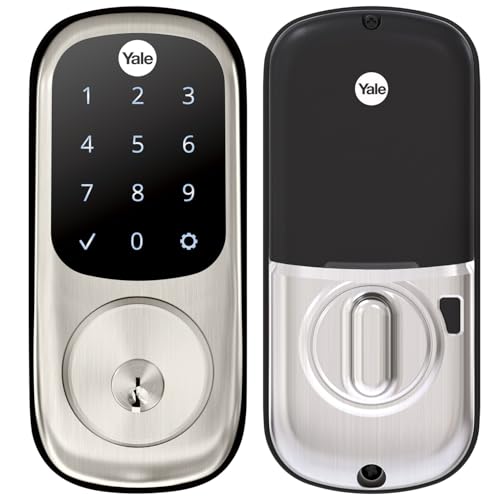
Yale Assure Deadbolt Lock with Touchscreen
Best for: Keyed doors planned for future smart upgrades
Pros
- Includes two physical keys
- Responsive touchscreen interface
- Modular network upgrade path
Cons
- Smart module sold separately
- No out-of-box app
The Yale Assure Deadbolt Lock with Touchscreen (model YRD226-NR-619) is a hybrid access solution suited for studios undergoing staged infrastructure upgrades. Out of the box, this deadbolt functions as an offline digital entry lock featuring a modern capacitive touchscreen keypad paired with a traditional physical keyway. It ships with two physical keys, installation mounting plates, and four AA batteries, fitting standard doors between 1-3/4 inches and 2-1/4 inches thick without requiring specialized routing or custom carpentry.
The primary advantage of this platform is its modular upgrade path. While it provides instant keyless access through on-screen PIN codes and automatic time-based deadbolt engagement, you can convert it into an interconnected smart lock at any point by sliding an optional Yale Access Upgrade Kit or smart module into the internal chassis. This allows creative teams to establish secure keypad deadbolt access immediately while retaining the freedom to bridge into wireless management systems later. Our detailed testing of yale wifi lock options illustrates how these modular locks behave once fitted with dedicated network radios.
The trade-off lies in the out-of-the-box feature set. Without the optional add-in module, you cannot issue remote guest codes, track timestamped entry histories, or trigger automated perimeter routines from your smartphone. Creators seeking out-of-the-box app functionality should instead select an Assure Lock 2 model.
05
Yale Assure Lock 2 Touchscreen Keypad
Best for: Modern creator studios prioritizing clean touchscreen access
Pros
- Direct dual-band Wi-Fi
- Fingerprint-resistant matte finish
- DoorSense auto-locking included
Cons
- No mechanical key backup
- Requires 9V emergency battery jump
For modern media facilities that demand maximum operational flexibility alongside sleek visual lines, the Yale Assure Lock 2 Touchscreen Keypad (model YRD450-WF1-BSP) delivers an all-in-one package. This yale keyless entry deadbolt omits the traditional mechanical keyway entirely, replacing it with an edge-to-edge capacitive touchscreen finished in an anti-smudge matte black suede coating. By eliminating physical buttons and wear patterns, the keypad prevents onlookers or unauthorized visitors from deducing frequently pressed code combinations.
Under the hood, this unit includes Yale’s dual-band Wi-Fi Smart Module, establishing direct communication over 2.4 GHz or 5 GHz bands straight to the Yale Access app. You can program unlimited temporary, recurring, or permanent entry credentials for editors, audio engineers, and facility cleaning crews without stepping foot in the building. Integrated DoorSense technology verifies true door closure before firing the motorized deadbolt, while proximity-based Auto-Unlock detects your paired smartphone or Apple Watch to open the door automatically when your hands are full of lighting cases and camera gear. Users looking for biometric alternatives can check our analysis of yale smart lock with fingerprint systems.
Because the YRD450 is completely key-free, there is no keyhole for physical lock bumping or emergency brass keys. In the event of unexpected battery depletion, users must utilize the external emergency terminal contacts or maintain diligent attention to the app’s low-battery warnings to prevent lockouts.
06
Yale Assure Deadbolt Lock
Known across the security industry as the Yale Assure Deadbolt Lock SL (model YRD256-NR-BSP), this model represents the slimmest digital hardware design in the Yale catalog. Engineered for high-end studio doors, modern glass-paneled office partitions, and contemporary creator spaces, the Assure Lock SL eliminates the bulky mechanical housing of conventional deadbolts. In its place is an ultra-slim, weather-resistant touchscreen escutcheon that sits practically flush against the exterior face of the door.
Like its keyed counterpart, this iteration is completely 100 percent key-free and ships as a non-connected digital lock ready for modular smart upgrades. It accepts 4 to 8 digit user PINs, features one-touch deadbolt engagement when leaving the room, and automates securing via adjustable auto-lock timers. When collaborative demands expand, the internal board accepts optional plug-in modules supporting Wi-Fi, Bluetooth, or Z-Wave, bridging the slim form factor directly into complex home automation networks. Those assembling specialized Apple workflows can explore dedicated yale homekit lock integrations using compatible module variants.
The primary constraint of the standalone YRD256 is its out-of-the-box configuration. You do not get out-of-the-box app control, remote guest management, or automated wireless locking without purchasing an optional upgrade module separately. Furthermore, the complete absence of a keyway means your team must rely strictly on PIN codes.
Matching a Model to Your Setup
- Commercial gear rooms and collaborative video studios needing instant guest codes, physical key backup, and remote status monitoring are best served by the Yale WiFi Smart Lock Deadbolt.
- Private isolation booths, utility storage rooms, and offline editing suites where wireless connections are unwanted or restricted function most reliably with the Yale Code Keypad Deadbolt for Keyless.
- Studios standardized around smart hubs and Matter-driven automation should select the Yale Keyed Deadbolt Smart Lock for efficient mesh-network operation via Google Home.
- Workspaces prioritizing a minimalist, modern aesthetic with zero mechanical key management and out-of-the-box cloud control will prefer the Yale Assure Lock 2 Touchscreen Keypad.
- Facilities planning phased technology upgrades who want a keyed deadbolt today with the option for wireless smart home control later should choose the Yale Assure Deadbolt Lock with Touchscreen.
- Contemporary creative offices wanting the slimmest possible keyless door profile with modular upgrade flexibility will find the best match in the Yale Assure Deadbolt Lock.
Before You Buy
Before selecting your deadbolt, verify your door thickness, backset, and bore hole dimensions against the manufacturer’s specifications. The standard Assure and Assure Lock 2 models accommodate standard door thicknesses ranging from 1-3/8 inches to 2-1/4 inches, though some models, like the YRD226 touchscreen, specify standard fitting between 1-3/4 inches and 2-1/4 inches (with doors under 1-3/8 inches requiring an optional thin door kit). While the Google Matter deadbolt includes an adapter for smaller 1-1/2 inch cross-bore holes, other models generally require standard 2-1/8 inch preparations. Ensuring your door latch pocket and strike plate are precisely aligned is vital; motorized deadbolts experience friction and excessive battery drain if the bolt encounters resistance while extending into the door jamb.
It is equally critical to understand what is not included in the standard retail packaging. While models such as the Assure Lock 2 include their respective Wi-Fi modules and DoorSense sensors out of the box, the non-connected models (YRD226, YED210, and YRD256) do not include wireless modules or DoorSense hardware. If you purchase an offline Assure model intending to use smartphone control immediately, you will need to purchase the Yale Access Upgrade Kit separately. Furthermore, while the Matter-enabled model operates on low-energy Thread mesh architecture, the listing states that remote access strictly requires an external Matter-enabled hub, which must be provided by your existing smart home network.
FAQ
Can I use the Yale Access app with any Yale smart deadbolt?
No. The Yale Access app only functions with deadbolts that feature built-in Wi-Fi and Bluetooth radios, such as the Assure Lock 2 models, or modular Assure locks that have been upgraded with the Yale Access Smart Module. Fully standalone models like the Yale Code Keypad Deadbolt for Keyless cannot connect to the mobile app under any circumstances, and the Yale Matter deadbolt uses the Google Home app rather than Yale Access.
What happens if the batteries die on a keyless Yale deadbolt?
On keyless models without a physical cylinder—such as the Assure Lock 2 Touchscreen or Assure Lock SL—you cannot unlock the door with a standard metal key. The locks provide advance low-battery warnings via LED indicators and app notifications. If the batteries drain completely while you are locked out, keyless touchscreen models feature external terminal points on the bottom of the escutcheon where you can press a standard 9-volt battery to provide temporary emergency power to enter your code.
Do Yale Wi-Fi locks require an external hub or bridge?
The Yale Assure Lock 2 Wi-Fi models (both the push-button and touchscreen variants) feature built-in dual-band Wi-Fi that connects directly to 2.4 GHz or 5 GHz home networks without requiring an external bridge or proprietary hub. However, the Yale Keyed Deadbolt Smart Lock with Matter requires an external Matter-enabled hub (such as a Google Nest Hub or Nest Wi-Fi Pro) acting as a Thread border router to facilitate remote internet control.
What is the benefit of DoorSense on Yale smart deadbolts?
DoorSense is a specialized magnetic door position sensor included with select models like the Assure Lock 2 series and the Google Matter lock. Standard smart deadbolts only know whether the motorized bolt is extended or retracted; they cannot tell if the door is actually closed. DoorSense detects whether the door slab is resting squarely in the frame before triggering the auto-lock feature, preventing the deadbolt from extending while the door is standing open.
Can I upgrade a non-connected Yale Assure lock to Wi-Fi later?
Yes. The modular non-connected models, including the YRD226 touchscreen and the YRD256 Assure Lock SL, are engineered with an internal expansion slot located above the battery compartment. You can purchase a compatible Yale Smart Module or Yale Access Upgrade Kit at a later date, install it into the chassis, and instantly gain wireless app control and smart ecosystem integration without replacing the deadbolt hardware.