As Amazon Associates, we earn from qualifying purchases. This means we may receive a small commission at no extra cost to you if you click through and make a purchase.
As an Amazon Associate we earn from qualifying purchases. Links on this page are affiliate links.
Finding the best PUJH electric bikes under $500 requires careful attention to published specifications. We compared 2 models to identify the top options based strictly on their listed data. The PUJH 4000W Dual Motor Fat Tire E-Bike leads this list because its 4000W motor and 25Ah battery provide the power and range needed for off-road terrain and long-distance commuting. Each pick here is ranked by measurable specs like voltage, suspension type, and tire size. This guide helps you decide which model fits your riding style and budget constraints.
Prioritize motor power and wheel size
Both PUJH models feature 4000W motors and full suspension for off-road traction. The key difference is wheel size. The top pick uses fat tires for long-distance stability. The second option uses 24-inch wheels for tighter torque control. Choose based on whether you need distance or agility. Both share 52V batteries and hydraulic brakes.
| # | Product | Best for | Price |
|---|---|---|---|
| 1 | PUJH 4000W Dual Motor Fat Tire E-Bike Best overall | off-road terrain and long-distance commuting | |
| 2 | PUJH 24" Fat Tire Ebike Best 24 inch | off-road traction and torque |
The best fit for you
- You want the best overall performance – PUJH 4000W Dual Motor Fat Tire E-Bike – This model features a 4000W dual motor and 52V 25Ah battery for maximum power.
- You prefer a smaller wheel size – PUJH 24" Fat Tire Ebike – It uses 24-inch fat tires for enhanced stability and traction on rough ground.
- You need hydraulic braking systems – PUJH 4000W Dual Motor Fat Tire E-Bike – Both bikes include hydraulic brakes, but this top pick offers dual suspension comfort.

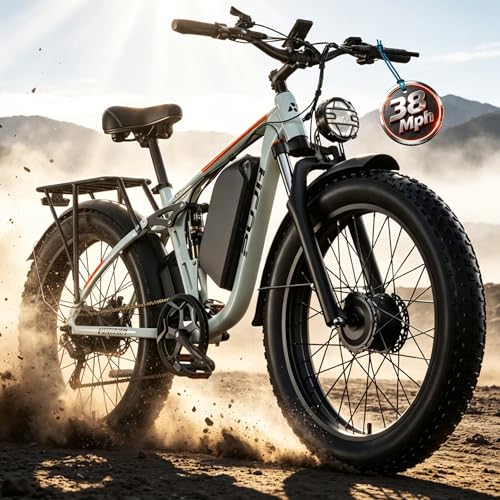
PUJH 4000W Dual Motor Fat Tire E-Bike
Best for: off-road terrain and long-distance commuting
- Motor Power
- 4000W
- Battery Capacity
- 25Ah (1300Wh)
- System Voltage
- 52V
- Maximum Range
- Up to 110 miles
- Top Speed
- Around 38 MPH
- Tire Size
- 24 x 4.0"
This PUJH e-bike features dual motors delivering 4000W of power and a 52V 25Ah battery for a range up to 110 miles. It rides on 24×4.0 inch fat tires and reaches speeds around 38 MPH. The full suspension and hydraulic brakes handle rough terrain. It suits riders needing high torque and long distance capability for off-road use.
- Dual motors provide 160 Nm of torque for steep hills
- 25Ah 1300Wh battery offers up to 110 miles of range
- Hydraulic brakes ensure precise stopping power at high speeds
- 24×4.0 inch fat tires offer superior grip on loose surfaces
- 85-pound weight makes the bike heavy to maneuver
- 76-inch length requires ample storage space
- X-Large size may not fit shorter riders comfortably
- You need high torque for steep or off-road terrain
- You prioritize long range over lightweight portability
- You ride on uneven surfaces like sand or gravel
- You need a lightweight bike for easy carrying
- You have limited storage space for a long frame
- You prefer a smaller frame for better maneuverability
Verdict: PUJH 4000W Dual Motor Fat Tire Ebike delivers serious power and range for heavy-duty off-road use. It fits riders who value torque and distance over portability and compact storage.

PUJH 24" Fat Tire Ebike
Best for: off-road traction and torque
- Motor Power
- 4000W
- System Voltage
- 52V
- Maximum Range
- 40-110 miles
- Tire Size
- 24 x 4.0"
- Brake Type
- Hydraulic disc
- Suspension
- Full suspension
The PUJH 24-inch fat tire e-bike uses a 52V battery and dual motors to deliver 160 Nm of torque. Its 24×4.0 inch tires and full suspension handle rough terrain. You get up to 110 miles of range. This model suits riders needing strong traction on loose surfaces. The 85-pound weight and 76-inch length define its physical footprint.
- Dual motors provide 160 Nm of torque
- 24×4.0 inch fat tires offer superior grip
- Full suspension with 7-level shock absorption
- Hydraulic disc brakes ensure stable stopping
- 52V 25Ah battery supports up to 110 miles
- 85-pound weight makes handling difficult
- 76-inch length requires significant storage space
- 24-inch wheels limit top speed compared to larger sizes
- You ride on sand, snow, or gravel
- You need high torque for steep hills
- You prefer full suspension for comfort
- You prioritize lightweight portability
- You have limited storage space
- You prefer larger 26-inch or 29-inch wheels
Verdict: PUJH 24-inch Fat Tire E-Bike fits riders who prioritize traction and torque over agility. It is ideal for off-road use where stability matters more than speed.
Specifications side by side
| Spec | PUJH 4000W Dual Motor Fat Tire E-Bike | PUJH 24" Fat Tire Ebike |
|---|---|---|
| Motor Power | 4000W | 4000W |
| Battery Capacity | 25Ah (1300Wh) | – |
| System Voltage | 52V | 52V |
| Maximum Range | Up to 110 miles | 40-110 miles |
| Top Speed | Around 38 MPH | – |
| Tire Size | 24 x 4.0" | 24 x 4.0" |
| Brake Type | Hydraulic | Hydraulic disc |
| Suspension | Full suspension | Full suspension |
| Bike Type | Fat Tire, Mountain | Fat Tire |
| Wheel Size | – | 24 Inch |
| Voltage | 52V | 52V |
| Color | White Pro | Black |
| Suitable For | Off-Road | Off-Road |
| Features | Dual Suspension, Dual Motor | Dual Suspension, Dual Motor |
| Tire Type | Fat Tires | Fat Tires |
| Dimensions | 76 × 29 × 45 inches | 76 × 29 × 45 inches |
| Weight | 85 pounds | 85 pounds |
| Size | X-Large | X-Large |
| Model | PU3 | PU354 |
How to Choose the Right PUJH E-Bike
Match motor power to terrain
Both models feature a 4000W motor, which provides substantial torque for climbing steep hills and accelerating quickly. This power level suits riders who plan to tackle off-road trails or carry heavy loads. If you primarily ride on flat pavement, this high output may be more than necessary. However, the dual-motor configuration ensures reliable performance in challenging conditions. Consider your typical route to determine if this level of propulsion aligns with your daily needs and expected speed requirements.
Select wheel size for stability
The top pick utilizes standard fat tires for a wider contact patch, enhancing stability over long distances. The second option features 24-inch wheels, which can offer tighter torque control and a slightly different ride feel. Larger wheels generally roll over obstacles more easily, while smaller wheels may provide quicker acceleration. Evaluate your preference for smooth cruising versus agile maneuvering. This spec directly influences how the bike handles bumps and uneven surfaces during your commute or recreational rides.
Check voltage for energy delivery
Both bikes operate on a 52V system, which delivers consistent power to the motors. Higher voltage systems often maintain performance better as the battery drains compared to lower voltage alternatives. This spec ensures that your acceleration remains strong even when the charge is not at its peak. It is a critical factor for maintaining efficiency on longer trips. Verify that your charging setup is compatible with this voltage standard to ensure safe and effective power replenishment between rides.
Evaluate battery capacity for range
The leading model includes a 25Ah battery, which supports extended range for off-road adventures and long commutes. A higher amp-hour rating generally translates to more miles per charge. This capacity is ideal if you frequently ride away from charging stations. Consider your typical daily distance to ensure the battery meets your requirements. Adequate capacity prevents range anxiety and allows for more flexible routing. Always check the manufacturer’s estimated range based on terrain and rider weight for accurate planning.
Assess suspension for comfort
Both e-bikes feature full suspension systems, including dual suspension components. This setup absorbs shocks from rough terrain, reducing fatigue on longer rides. Hydraulic brakes are also included, providing reliable stopping power in various weather conditions. Full suspension is particularly beneficial for off-road use where ground irregularities are common. If you ride on paved roads, you might find less suspension sufficient. However, for mixed-terrain riding, this feature significantly enhances control and rider comfort.
Frequently asked questions
Are PUJH electric bikes suitable for off-road terrain?
Yes. Both models in this list are rated for off-road use. They feature full suspension and hydraulic brakes to handle rough ground. The top pick includes fat tires for added stability on uneven surfaces. The second option uses 24-inch wheels to maintain traction and torque control on trails.
How much weight can these PUJH e-bikes carry?
The listed weight for both the top pick and the second option is 85 pounds. This is the bike's own weight, not the rider capacity. You should check the manufacturer’s maximum load limit in the full product specifications. These frames are built for heavy-duty use with dual motors.
What is the difference between the two PUJH models?
The main difference is wheel size. The top pick uses standard fat tires for long-distance stability. The second option features 24-inch wheels for tighter torque control. Both have 4000W dual motors and 52V batteries. Your choice depends on whether you prioritize distance comfort or agile off-road handling.
Do these bikes have hydraulic brakes?
Yes. Both the top pick and the second option are equipped with hydraulic brakes. This system provides consistent stopping power, which is essential for heavy e-bikes on steep descents. Hydraulic brakes require less hand force than mechanical ones, offering better control during intense off-road riding or commuting.
Is a 4000W motor too powerful for daily commuting?
It depends on your needs. A 4000W motor delivers substantial torque for quick acceleration and climbing hills. If you only ride on flat pavement, this power may be excessive. However, if you mix city streets with rough paths, the extra power ensures you can handle varied terrain without struggling.
What battery voltage do these PUJH bikes use?
Both models use a 52V battery system. The top pick also lists a 25Ah capacity. Higher voltage generally supports higher motor power output. This setup helps maintain speed under load. You should verify the exact range based on your riding style and terrain conditions for each specific model.


