As Amazon Associates, we earn from qualifying purchases. This means we may receive a small commission at no extra cost to you if you click through and make a purchase.
Operating a fabrication space inside a residential garage or creative studio requires careful electrical planning, making a reliable miller 110 welder an essential centerpiece for clean metalwork without high-voltage utility installs. Small-scale builders, custom furniture makers, and automotive hobbyists face the challenge of balancing low-amperage input constraints against the desire for smooth arc stability, sufficient penetration, and material flexibility. Choosing between dedicated wire-feed machines, all-in-one multi-process power sources, portable stick units, and matched optical gear comes down to knowing how your duty cycle and daily joint designs align with household power limits. Exploring miller welders for sale reveals how modern inverter technology bridges the gap between plug-and-play convenience and industrial-grade bead aesthetics.
The Miller electric lineup for dual-voltage and low-voltage workshop applications is organized around clear workflow tiers, spanning from focused single-process units to full-spectrum fabrication workstations. At the entry point for wire fabrication, dedicated MIG units deliver automated parameter tuning for users who weld sheet steel and tube assemblies every day. Stepping up within the catalog introduces multiprocess platforms that incorporate DC TIG and stick capabilities, culminating in advanced systems capable of AC TIG for aluminum. Across these power supplies, Miller utilizes a toolless multi-voltage plug system, allowing fabricators to plug into a standard household wall outlet today while preserving the headroom to draw full industrial amperage from a 240V supply later. Completing the ecosystem, specialized optical safety gear ensures that operators maintaining low-amperage arcs can track their puddle with exceptional visual clarity. Understanding this structure simplifies any miller welder comparison when deciding which miller welder to buy for your workshop footprint.
This guide by the numbers
9.4/10
Best rated model
Our highest score in this line-up
5
Models on file
Models in this guide that have a stored product record
1
Brand involved
Distinct brand names on the product records used here
Prices and specifications come from the stored Amazon listing data for the products in this article. Scores are out of 10, based on listed specifications and buyer feedback.
Miller 110V Welders Lineup at a Glance
| Model | Processes Supported | Input Voltage | Primary Workflow Focus |
|---|---|---|---|
| Millermatic 211 PRO MIG Welder Machine | MIG, Flux-Cored, Dyna-Pulse MIG | 120V / 240V (MVP Plug) | Production-grade wire feeding and auto-set parameters |
| Miller Multimatic 215 PRO Multiprocess Welder | MIG, Pulsed MIG, TIG (DC), Pulsed TIG, Stick | 120V / 240V (MVP Plug) | Versatile three-process fabrication with digital bead monitoring |
| Miller Electric Stick Welder | SMAW (Stick) including E6010 | 120V / 240V (Disconnect Cords) | Compact field repairs, dirty steel, and structural stick welding |
| Miller 907757 Multimatic 220 AC DC | MIG, Flux-Cored, Stick, AC TIG, DC TIG | 120V / 240V (MVP Plug) | Complete studio fabrication including thin-gauge AC aluminum TIG |
| Miller Classic Series Welding Helmet | Optical PPE (Shades 8-13, Cut 5-8, Grind 3) | Battery / Solar Auto-On | Visual puddle inspection down to five-amp sensitivity |
The Models in Detail
01
Millermatic 211 PRO MIG Welder Machine

Millermatic 211 PRO MIG Welder Machine
Best for: Dedicated MIG and flux-cored garage fabrication
Pros
- Dyna-Pulse MIG capability
- BeadVision real-time monitoring
- Tool-free dual-voltage MVP plug
Cons
- Spool gun sold separately for aluminum
- Single-process wire feeding only
The Millermatic 211 PRO MIG Welder Machine represents a dedicated approach to wire-feed fabrication, engineered specifically for makers who focus on mild steel, stainless steel, and flux-cored welding without requiring multi-process complication. Powered by continually upgradable USB software, this unit incorporates Dyna-Pulse MIG alongside BeadVision, giving operators real-time visual bead monitoring directly through the interface to dial in bead profile consistency. For hobbyists moving past entry-level alternatives like a yeswelder mig welder, the millermatic 211 pro delivers industrial arc control thanks to Auto-Set parameter matching and a Smooth-Start feature that virtually eliminates initial spatter upon arc ignition.
On the hardware side, the listing specifies an angled cast-aluminum drive mechanism with a Quick Select drive roll supporting 0.024-inch to 0.035-inch wire. An integrated auto-detect system senses when a spool gun is attached, streamlining the switch to aluminum wire without requiring manual toggling inside internal menus. The power architecture relies on Miller Electric Multi-Voltage Plug (MVP) technology, permitting seamless transitions between 120V wall receptacles and 240V shop plugs without tools. The unit weighs 47.6 pounds, measures 23.75 by 19 by 13.25 inches, includes a 15-foot MIG gun, and lists its power source specification as fuel_powered under model number 907839.
This machine is the best miller 110 welder for makers whose creative projects consist predominantly of structural steel frames, sheet metal enclosures, and tube chassis work where rapid wire deposition is prioritized. It provides deep parameter memory to save recurrent joint profiles, giving fabricators repeatable quality across work sessions. However, the 211 PRO yields to the Multimatic series the moment your shop requires tungsten arc welding or dedicated electrode stick burning, as it remains strictly a wire-feed platform.
02
Miller Multimatic 215 PRO Multiprocess Welder
Miller Multimatic 215 PRO Multiprocess Welder
Best for: Multi-process fabricators needing pulsed arc control
Pros
- Handles MIG, TIG, and Stick
- Pulsed MIG and Pulsed TIG modes
- Toolless 120V and 240V MVP connectivity
Cons
- Lacks AC output for aluminum TIG
- Heavier cabinet at 55 pounds
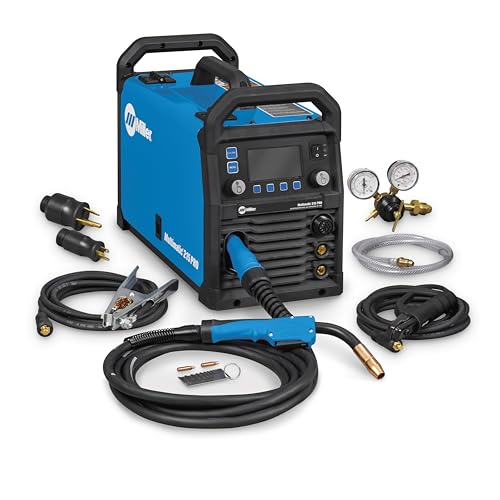
Fabricators who need process diversity in a single footprint will look toward the Miller Multimatic 215 PRO Multiprocess Welder. Listed under model number 907840, this unit integrates MIG, Pulsed MIG, DC TIG, Pulsed TIG, and stick welding capabilities into a single compact housing. Operating as a highly adaptable miller 120v welder, it delivers multi-process flexibility supported by continually upgradable USB software, BeadVision puddle monitoring, and Program Memory to recall preferred setup configurations. Auto-Set technology supplies predetermined baseline parameters across multiple material thicknesses, getting users burning wire or running tungsten quickly without trial-and-error scrap testing.
According to its product specifications, the machine operates on a DC power source and connects to 120V or 240V circuits using toolless MVP adapters. When running on standard 120V household power, the listing states the machine handles MIG welding on steel up to 3/16-inch thick, expanding to 3/8-inch capacity when connected to 240V. Mechanical inclusions feature an angled cast-aluminum drive with a calibrated tension knob, a Quick Select drive roll sporting three grooves, and support for 4-inch or 8-inch spools handling 0.024- to 0.035-inch solid wire or 0.030- to 0.045-inch flux-cored wire. The package weighs 55 pounds, measures 24 by 14 by 19 inches, includes a 15-foot MIG gun, and incorporates Fan-On-Demand cooling to reduce shop dust ingestion.
The miller multimatic 215 pro is ideal for dynamic craft spaces where an artisan might tack mild steel framework using solid MIG in the morning and switch to precision DC TIG on stainless exhaust sections in the afternoon. It provides an all-in-one upgrade path for shops with shifting creative demands. Where it yields is in specialized aluminum work: because its TIG circuit is DC only, operators needing high-purity TIG welding on aluminum must upgrade to an AC-capable platform or rely on a spool gun on the MIG side.
03
Miller Electric Stick Welder

Miller Electric Stick Welder
Best for: Mobile field repairs requiring dedicated stick welding
Pros
- Smoothly runs difficult E6010 electrodes
- Includes heavy-duty protective X-Case
- Detachable tool-free dual-voltage power cords
Cons
- Limited to stick welding only
- Listing specifies no warranty included
For fabricators tackling outdoor sculpture, agricultural maintenance, or heavy structural steel where paint and mill scale make wire feeding impractical, the Miller Electric Stick Welder provides specialized shielding metal arc performance. Representing the Maxstar 161 S series under part number 907709001, this unit is engineered for extreme portability and dependable arc starts. The listing highlights its superior stick arc stability, noting its ability to smoothly burn notoriously difficult-to-run electrodes like cellulosic E6010, which demand significant voltage overhead during aggressive arc digging.
Dual-voltage operation is achieved through separate 120V and 240V power cords that disconnect cleanly from the machine rear panel without hand tools. According to the manufacturer listing data, the machine delivers a rated output of 110 Amps at 24.4 VDC on a 20 percent duty cycle. Dimensional specifications record a total shipping weight of 36 pounds across a 30.6 by 10.7 by 13.7 inch form factor, while the description text emphasizes an ultra-portable core design weighing just 13 pounds. The product package includes Miller Electric rugged X-Case for transport protection, while the listing catalog curiously lists “Bra” under included components and marks warranty coverage as “No Warranty.”
The miller maxstar 161 s is the definitive pick for mobile operators and studio artists who frequently weld outside, restore rusty implements, or need an emergency repair rig that operates effortlessly from household circuits. Its compact casing and rod-burning performance make it unmatched for structural reliability in harsh environments. However, it gives way entirely to wire-feed units when working with thin sheet steel or production joints where continuous feeding and zero slag cleanup are necessary.
04
Miller 907757 Multimatic 220 AC DC

Miller 907757 Multimatic 220 AC DC
Best for: Fabricators wanting all processes including AC TIG
Pros
- True AC and DC TIG capability
- QuickTech automatic polarity switching
- Includes TIG torch and foot control
Cons
- Heaviest unit at 56 pounds
- Complex features for simple jobs
The Miller 907757 Multimatic 220 AC DC represents the pinnacle of compact workshop versatility, bridging the gap between standard household convenience and full-spectrum industrial welding capabilities. As a true multi-process workstation, it accommodates MIG, flux-cored, stick, DC TIG, and crucially, AC TIG welding. This AC capability allows studio fabricators to execute high-purity, aesthetic TIG joints on aluminum without resorting to a mechanical spool gun. QuickTech automation actively manages the machine internal setup by detecting arc strike activity, automatically switching process modes and polarities while recalling the exact parameters from the previous operational session.
The specification sheet for model 907757 highlights a 56-pound unit rated for residential use that runs on 120V or 240V input via the multi-voltage plug system, with additional certification for generators rated at 10,000 watts or higher. In terms of capacity, it manages mild steel penetration up to 3/8-inch. Parameter setup is guided by Auto-Set Elite and Pro-Set systems, which present operators with refined parameter bands to ensure proper penetration without guesswork. The welder package includes extensive accessories right out of the box: a primary MIG gun, a dedicated TIG torch, a TIG torch accessory kit, a flux-cored wire drive roll, and a heavy-duty foot control pedal.
For custom automotive fabricators, motorsports artisans, and multidisciplinary makers, the miller multimatic 220 ac dc is the premier all-in-one solution that eliminates the need for multiple heavy power sources. It handles everything from body panels to thick brackets and aluminum intake piping. Its main limitation is physical bulk and complexity: at 56 pounds, it is the heaviest power supply in the roundup, making it less convenient for constant job-site transport than a dedicated stick or single-process unit.
05
Miller Classic Series Welding Helmet
Best for: Eye protection across all workshop welding processes
Pros
- ClearLight high-definition optics
- Sensitive down to five amps
- Includes grind and cut shade modes
Cons
- Compact 6-square-inch viewing area
- Dual sensors instead of four
Achieving structural penetration on a 110V circuit requires flawless optical awareness of the molten weld pool, making the Miller Classic Series Welding Helmet an integral companion to any workshop power source. Built with a nylon shell under part number 287803, this auto-darkening hood features ClearLight lens technology, delivering natural color representation and high-definition clarity across the weld puddle. The optical system remains sensitive down to five amps or below, ensuring reliable lens darkening even when performing delicate, low-amperage TIG passes on delicate metal projects. Fabricators who spend long hours under the hood often pair this gear with comfortable welder nation welding caps to prevent chafing and manage sweat during extended fabrication runs.
The helmet provides a six-square-inch viewing area governed by dual arc sensors with an ultra-fast switching speed of 1/23,000th of a second. Integrated digital controls allow users to dial in variable shade levels from 8 to 13 for welding, shades 5 to 8 for torch cutting, and a dedicated shade 3 grind mode. An auto-on power control automatically engages the cartridge at the strike of an arc, while the clear 3.0 light state allows fabricators to keep their hood down between welds for improved shop efficiency and eye protection. The assembly features an adjustable ratchet headgear mechanism, meets ANSI Z87.1+, CSA, and CE industrial safety standards, and carries a three-year manufacturer warranty.
This auto-darkening helmet suits value-minded makers who need dependable eye safety across stick, MIG, and low-amp TIG operations without unnecessary complexity. Its optical filtering reduces eye fatigue and promotes precise torch positioning on intricate studio pieces. The primary operational trade-off is the compact six-square-inch viewport and two-sensor arrangement, which requires a direct line of sight to the arc compared to premium wider-view four-sensor helmets designed for out-of-position structural welding.
Matching a Model to Your Setup
- Home Garage Automotive Restorers: The Millermatic 211 PRO MIG Welder Machine provides the ideal blend of fine-gauge sheet metal control, spatter-free arc starts, and auto-set convenience for welding floor pans and body panels.
- Artisans and Multidisciplinary Makers: The Miller Multimatic 215 PRO Multiprocess Welder delivers the process agility needed to switch between heavy steel MIG brackets and clean DC TIG art pieces using a single 120V outlet.
- Outdoor Gate and Equipment Fixers: The Miller Electric Stick Welder offers unmatched portability in its protective X-Case, allowing operators to run aggressive E6010 rods on corroded, dirty, or painted steel far from the main workbench.
- Motorsports Fabricators Requiring Aluminum TIG: The Miller 907757 Multimatic 220 AC DC stands as the complete single-machine solution, delivering AC TIG capability for aluminum tubing along with standard MIG and stick power.
- Safety-First Workshop Beginners: The Miller Classic Series Welding Helmet equips any fabricator with clear puddle vision down to five amps, shielding against flash while providing an integrated grind mode for prep work.
Before You Buy
When selecting a portable miller welder for low-voltage residential use, it is critical to note what the product listings do not supply. While dual-voltage machines like the 211 PRO, 215 PRO, and 220 AC/DC come with multi-voltage MVP plugs or adapters, they do not include shielding gas cylinders, regulators for secondary gases, or welding wire consumables in the primary carton. Furthermore, while the 211 PRO and 215 PRO feature internal auto-detect circuitry for spool guns, the actual spool gun required to push soft aluminum wire must be acquired separately. Studio makers must also verify their wall breaker ratings: while these machines operate on 120V power, running near the upper boundary of their 120V duty cycle will often trip common 15-amp household breakers, frequently requiring a dedicated 20-amp branch circuit for continuous arc stability.
Shoppers should also pay close attention to specification discrepancies and listing omissions across product packages. For example, the Miller Maxstar 161 S listing records a shipping package weight of 36 pounds alongside an internal descriptive weight of 13 pounds, while cataloging an anomalous “Bra” under included components and noting “No Warranty” in the technical overview table despite the line traditional industrial standing. Similarly, while the Multimatic 220 AC/DC supplies a comprehensive kit containing a TIG torch and foot control, the Multimatic 215 PRO package focuses on the MIG gun and does not specify a TIG torch or foot pedal in its standard listing inventory. Reading the exact component breakdown ensures you budget accurately for necessary torches, ground clamps, and personal protective equipment before striking your first arc.
FAQ
Can a Miller 110V welder run on a standard 15-amp household wall outlet?
Yes, Miller dual-voltage welders equipped with the Multi-Voltage Plug (MVP) can physically connect to a standard 120V 15-amp household circuit using the included toolless adapter. However, welding thicker metal near the machine maximum 120V output will draw significant current that can trip a standard 15-amp breaker during extended passes. For consistent performance and to prevent breaker interruptions, connecting the welder to a dedicated 20-amp household circuit is highly recommended.
What is the difference between the Millermatic 211 PRO and the Multimatic 215 PRO?
The fundamental difference lies in process capability. The Millermatic 211 PRO is a specialized wire-feed unit that focuses purely on MIG and flux-cored welding, featuring Dyna-Pulse MIG technology and an angled cast-aluminum drive system. In contrast, the Multimatic 215 PRO is a true multiprocess power source that handles MIG, Pulsed MIG, DC TIG, Pulsed TIG, and stick welding in a single housing, making it significantly more versatile for diverse studio workflows.
Can the Miller Multimatic 215 PRO weld aluminum using the TIG process?
No, the Multimatic 215 PRO features a DC-only TIG output, which is designed for mild steel, chromoly, and stainless steel fabrication. Welding aluminum via TIG requires alternating current (AC) to break through the tough oxide layer on the metal surface. If you need to weld aluminum with the 215 PRO, the listing indicates you must use its MIG process paired with an optional auto-detected spool gun. For genuine AC TIG welding on aluminum, the Multimatic 220 AC/DC is the appropriate machine.
How does the Miller MVP plug system work without tools?
The Miller Multi-Voltage Plug (MVP) system uses a keyed, molded connector on the end of the primary power cord. Fabricators simply align the specific plug adapter—either the standard 120V household three-prong connector or the 240V industrial configuration—and screw the collar tight by hand. It requires no hand tools, wire strippers, or electrical disassembly, allowing users to alternate between garage wall receptacles and high-voltage generator power in seconds.
Why is the Miller Classic Series helmet suitable for low-amperage welding?
The Miller Classic Series helmet incorporates high-definition ClearLight lens technology and arc sensors calibrated to react to arcs rated down to five amps or below. Many low-voltage 110V TIG applications operate at low amperages where lower-tier optical sensors fail to detect the arc, resulting in dangerous lens flickering. The Classic Series maintains dependable auto-darkening across shades 8 through 13 even during delicate low-current studio work.