As Amazon Associates, we earn from qualifying purchases. This means we may receive a small commission at no extra cost to you if you click through and make a purchase.
High-end workstation workloads like 4K video rendering, 3D simulation, and multi-track audio mastering place intense, sustained demands on desktop hardware. While traveling content teams might rely on a gensrock portable power station for remote shoots, stationary editing suites require a reliable internal asus 1200w power supply. Modern graphics cards generate steep power transients across dedicated 16-pin power connections, making electrical stability, thermal dissipation, and acoustic suppression vital considerations. Determining which asus power supply 1200w model delivers the cleanest power ensures your workstation avoids sudden power trips during critical project exports, helping you secure the best asus 1200w psu for your production setup.
The ASUS power supply catalog is organized into dedicated product tiers defined by efficiency certifications, internal component architecture, and chassis form factors. In this asus power supply comparison, models range from the resilient TUF Gaming line and high-efficiency ROG Strix series to the compact ROG Loki family and flagship ROG Thor tier. Across these categories, engineering differentiators include gallium nitride (GaN) MOSFET power stages, patented GPU-First Intelligent Voltage Stabilizers, specialized 12V-2×6 power cabling, Cybenetics Lambda noise ratings, and integrated telemetry displays. Analyzing how these technical specifications translate into daily operational reliability clarifies which asus power supply to buy for your creative workstation.
This guide by the numbers
9.6/10
Best rated model
Our highest score in this line-up
6
Models on file
Models in this guide that have a stored product record
1
Brand involved
Distinct brand names on the product records used here
Prices and specifications come from the stored Amazon listing data for the products in this article. Scores are out of 10, based on listed specifications and buyer feedback.
ASUS Power Supply Lineup at a Glance
| Model | Wattage | Efficiency Certification | Form Factor |
|---|---|---|---|
| ASUS ROG Strix 1200W Platinum | 1200W | 80 PLUS Platinum / Cybenetics Platinum | ATX |
| ASUS TUF Gaming 1200W Gold | 1200W | 80 PLUS Gold | ATX |
| ASUS ROG Strix 1200W Platinum | 1200W | 80 PLUS Platinum | ATX |
| ASUS ROG Thor Platinum III 1200W | 1200W | 80 PLUS Platinum | ATX |
| ASUS ROG Loki SFX-L 1200W Titanium | 1200W | 80 PLUS Titanium | SFX-L |
| ASUS ROG Strix 1000W Platinum | 1000W | 80 PLUS Platinum | ATX |
The Models in Detail
01
ASUS ROG Strix 1200W Platinum
Best for: Moderately powered single-GPU content creation suites
Pros
- 80 Plus Platinum efficiency
- Lambda A+ acoustic rating
- GPU-First voltage stabilizer
Cons
- 1000W output ceiling
- Listed 237.6V minimum input

ASUS ROG Strix 1200W Platinum
Best for: Editing systems requiring GPU voltage stabilization
Pros
- GPU-First voltage stabilizer
- Dual fan cooling configuration
- Wide 100V-240V input support
Cons
- Lacks real-time telemetry screen
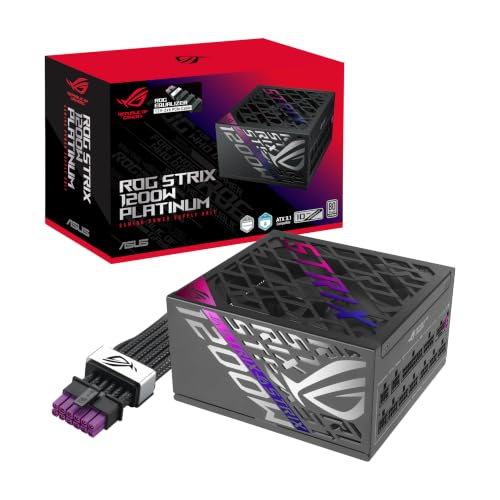
ASUS ROG Strix 1200W Platinum
Best for: Workstations demanding graphics cable thermal protection
Pros
- GaN MOSFET architecture
- ROG Equalizer 12V-2×6 cable
- Lambda A+ noise certification
Cons
- Listed 120V input voltage only
The ASUS ROG Strix 1200W Platinum is engineered specifically to deliver stable, high-efficiency power during heavy compute sessions. At the center of its internal design is a GaN MOSFET configuration that increases electrical efficiency by up to 30 percent while creating a more organized layout for cooler thermal operation. To protect modern high-power graphics cards, this unit integrates the patented GPU-First ROG Intelligent Voltage Stabilizer, enhancing voltage delivery directly to the graphics card by up to 45 percent. It also includes the patented ROG Equalizer 12V-2×6 PCIe power cable, engineered to reduce thermal stress and keep cable and connector temperatures well controlled.
Electrically, the unit holds dual 80 PLUS Platinum and Cybenetics Platinum certifications, utilizing low-ESR capacitors and premium internal components. It achieves a Cybenetics Lambda A+ noise certification, confirming noise levels below 20 decibels, while 0dB technology allows the fan to stop entirely during light workloads. Compliant with ATX 3.1 standards, the unit provides a 16-pin 12V-2×6 connection, four 6+2-pin PCIe leads, two 4+4-pin CPU leads, six SATA ports, and three peripheral connectors. Specifications list a 120-volt input rating, a 25-amp output current, a 4-pound weight, dimensions of 6.29 by 5.9 by 3.38 inches, and a 10-year warranty.
This power supply suits video editors, 3D animators, and visual effects artists who operate top-tier desktop graphics cards under prolonged export loads where connector thermal buildup is a primary concern. Where it gives way to other options in the range is in physical size and monitoring features: creators requiring real-time external wattage meters will prefer the ROG Thor Platinum III, while builders assembling small-form-factor editing workstations will look to the compact ROG Loki.
02
ASUS TUF Gaming 1200W Gold

ASUS TUF Gaming 1200W Gold
Best for: Challenging production environments with dust or moisture
Pros
- Protective PCB coating
- Military-grade certified components
- Dual ball fan bearings
Cons
- 80 Plus Gold rating
- 216V minimum listed input
The ASUS TUF Gaming 1200W Gold emphasizes component resilience and environmental protection for workstations operating in active studio environments. Its defining feature is a protective PCB coating that shields delicate internal traces against moisture, airborne dust, and extreme operating temperatures. In addition, internal capacitors and chokes have passed rigorous testing to achieve military-grade certification, while the single cooling fan uses dual ball bearings designed to last up to twice as long as traditional sleeve bearing alternatives.
This fully modular power supply achieves an 80 PLUS Gold certification through the use of Japanese capacitors and high-grade internal components. Compliant with ATX 3.1 guidelines, it includes a bundled 16-pin PCIe cable capable of delivering up to 600 watts directly to PCIe Gen 5.0 graphics cards. Listing specifications detail an ATX footprint measuring 5.9 by 5.9 by 3.4 inches, a 16-pin system bus connection, a single cooling fan, a 10-year warranty, and an input voltage range between 216 volts and 240 volts.
This model serves makers, industrial video producers, and workshop creators whose editing computers operate in dusty garages, studios, or humid environments where ambient airborne debris could threaten sensitive electronics. It concedes to the ROG Strix and ROG Thor units whenever absolute acoustic silence below 20 decibels or Platinum-level electrical efficiency is an absolute workflow requirement.
03
ASUS ROG Strix 1200W Platinum
This variant of the ASUS ROG Strix 1200W Platinum is built around active air cooling volume and wide international electrical compatibility. Like its counterpart, it incorporates next-generation GaN MOSFET technology to boost efficiency by up to 30 percent while organizing the internal layout for cooler operation. The patented GPU-First intelligent voltage stabilizer enhances voltage delivery directly to your graphics card by up to 45 percent, preventing transient voltage dips during GPU-accelerated video rendering and 3D viewport navigation.
Thermal management is handled by large ROG heatsinks covering critical power delivery stages, paired with a dual-fan air cooling configuration detailed in the listing specifications. The cooling fans feature dual ball bearings for extended lifespan, alongside 0dB technology for silent operation during lighter computing tasks. The fully modular unit complies with ATX 3.1 standards, holds an 80 PLUS Platinum certification, features a 24-pin system bus connection, and supports a flexible input voltage span ranging from 100V to 240V AC. Physical dimensions measure 6.3 by 5.9 by 3.4 inches.
This power supply suits workstation builders who require broad 100V to 240V global voltage support and dual-fan air cooling. However, users who require the specific thermal-reducing ROG Equalizer cable found on the initial Strix listing, or creators wanting live external watt readouts, will prefer other models in the ASUS lineup.
04
ASUS ROG Thor Platinum III 1200W

ASUS ROG Thor Platinum III 1200W
Best for: Flagship workstations needing continuous power draw monitoring
Pros
- Magnetic real-time OLED display
- Turbo Mode excursion support
- Pliable etched modular cables
Cons
- Long 7.48-inch casing length
The ASUS ROG Thor Platinum III 1200W serves as the flagship power supply for high-end showcase workstations and professional creative suites. Its headline feature is a magnetic OLED display that provides real-time readouts of system power draw in watts; the display can be unclipped and swapped to either side of the chassis to accommodate fan-up or fan-down installations. Beneath its fully aluminum enclosure, the unit features GaN MOSFET technology for up to 30 percent greater efficiency than standard MOSFETs, alongside GPU-First voltage sensing that enhances voltage delivery to the graphics card by up to 45 percent.
Thermal performance is supported by ROG heatsinks and a dedicated Turbo Mode, which utilizes premium components and an aggressive fan curve to unlock extended support for power excursions. Compliant with ATX 3.1 standards and certified 80 PLUS Platinum, the unit incorporates Aura Sync RGB lighting and includes etched modular cables crafted from pliable material for clean routing. Specifications list an input voltage range of 100V to 240V AC, a single dual ball bearing fan, a 20+4 pin system bus connector, and chassis dimensions of 7.48 by 5.91 by 3.39 inches.
The Thor Platinum III is crafted for visual artists, professional livestreamers, and colorists who maintain showcase PC cases and require instant hardware-level visibility into real-time power draw during heavy rendering spikes. Its extended 7.48-inch chassis length requires substantial internal clearance, causing it to yield to the ROG Strix or compact ROG Loki when building inside smaller desktop enclosures.
05
ASUS ROG Loki SFX-L 1200W Titanium
Best for: Small form factor creator rigs and ITX builds
Pros
- Compact SFX-L profile
- 80 Plus Titanium efficiency
- 120mm PWM ARGB fan
Cons
- ATX 3.0 specification
- Lambda Standard ++ noise tier
Engineered for high-density small-form-factor builds, the ASUS ROG Loki SFX-L 1200W Titanium provides massive output in a compact footprint. Measuring just 4.9 by 4.9 by 2.5 inches and weighing 2.15 kilograms, it achieves an 80 PLUS Titanium efficiency certification, representing the highest electrical efficiency rating in this lineup. Thermal control is managed by internal ROG heatsinks and a 120mm PWM ARGB fan equipped with dual ball bearings and Aura Sync lighting integration.
The cooling fan features 0dB technology to completely eliminate fan noise during low-load desktop operations, earning a Cybenetics Lambda Standard ++ certification for sound levels below 35 decibels. The unit adheres to ATX 3.0 guidelines and comes bundled with a 16-pin PCIe cable capable of delivering up to 600 watts to PCIe Gen 5.0 graphics cards. Connectors detailed in the listing include two 4+4-pin CPU leads, four 6+2-pin PCIe leads, and six SATA ports, all backed by a 10-year warranty.
This power supply is tailored specifically for traveling videographers, mobile creators, and desk space-conscious editors assembling compact Mini-ITX or Micro-ATX workstations. When building inside standard mid-tower or full-tower cases, however, full-sized ATX models like the ROG Strix or Thor provide larger cooling fans, lower acoustic ratings, and ATX 3.1 compliance.
06
ASUS ROG Strix 1000W Platinum
The ASUS ROG Strix 1000W Platinum provides an alternative power ceiling for creative suites that do not require a full 1200-watt output. For audio engineers who also maintain clean power across analog sound gear, maintaining isolated electrical delivery is just as critical as selecting a joyo power supply on an instrument bench, making this unit’s low-noise profile an asset. It incorporates GaN MOSFET technology to boost efficiency by up to 30 percent while maintaining a cool, organized internal layout. The patented GPU-First intelligent voltage stabilizer enhances GPU voltage delivery by up to 45 percent during intense editing tasks.
Acoustic dampening is a primary strength, as the unit holds a Cybenetics Lambda A+ certification confirming operating noise under 20 decibels. Dual ball fan bearings, large ROG heatsinks, and 0dB technology ensure silent operation during lighter computing tasks. Fully modular and compliant with ATX 3.1 standards, the unit carries an 80 PLUS Platinum certification, a 20+4 pin main connection, PCI Express and SATA leads, a 10-year warranty, dimensions of 6.3 by 5.9 by 3.4 inches, and an input voltage range between 237.6V and 264V AC.
This 1000-watt model is ideal for single-GPU video editing and audio mastering workstations seeking high Platinum efficiency without surplus capacity. It steps aside in favor of the 1200-watt ROG Strix, TUF, or Thor models whenever dual compute accelerators or extreme multi-drive editing configurations are required.
Matching a Model to Your Setup
- Acoustic-Sensitive Video Editing Suites: The ASUS ROG Strix 1200W Platinum with the ROG Equalizer cable delivers Lambda A+ certified noise suppression below 20 decibels alongside specialized thermal cable protection for long render sessions.
- Workshops and Humid Maker Spaces: The ASUS TUF Gaming 1200W Gold matches dusty studio environments through its conformal PCB coating and military-grade certified capacitors.
- International Workstations: The dual-fan ASUS ROG Strix 1200W Platinum supports creators working across varied facilities with its wide 100V to 240V AC input range.
- Showcase Desktops Demanding Live Metrics: The ASUS ROG Thor Platinum III 1200W suits open or glass-panel systems where creators need real-time power draw metrics via the magnetic OLED display.
- Space-Constrained Mini-ITX Creator Rigs: The ASUS ROG Loki SFX-L 1200W Titanium fits small-footprint cases, supplying 80 PLUS Titanium efficiency within a compact 4.9-inch chassis.
- Single-GPU Content Creation Desktops: The ASUS ROG Strix 1000W Platinum suits focused editing setups requiring Platinum efficiency and silent Lambda A+ operation without unneeded 1200W capacity.
Before You Buy
Field filmmakers evaluating off-grid power frequently turn to a bluetti 1800w portable power station to manage production gear on location, but fixed studio workstations demand that you carefully verify physical chassis clearances and native electrical specs before making a final selection. While ASUS listings specify primary output power and efficiency grades, several crucial technical details remain unspecified. For example, the first ROG Strix 1200W Platinum listing explicitly states an input voltage of 120 volts and notes enclosure material as information not available. Conversely, the TUF Gaming 1200W Gold and ROG Strix 1000W Platinum listings specify elevated minimum input voltages of 216V and 237.6V respectively, meaning prospective buyers must verify that their facility’s electrical supply matches these listed parameters.
Furthermore, product listings do not specify individual cable harness lengths or individual wire gauges across the included modular sets. While the ROG Thor Platinum III highlights pliable etched modular cables and the initial ROG Strix model includes the ROG Equalizer cable, the listings do not specify whether an SFX-to-ATX adapter bracket is bundled with the ROG Loki, nor do they detail exact thermal trip temperatures for the 0dB fan modes. Measuring internal case depth is especially critical for the 7.48-inch ROG Thor chassis to prevent clearance conflicts with internal drive bays and modular cable routing.
FAQ
What is the benefit of a GaN MOSFET in an ASUS power supply?
According to the ASUS specifications, GaN (gallium nitride) MOSFETs increase internal electrical power efficiency by up to 30 percent compared to conventional silicon transistors. This enhanced efficiency allows for a more organized internal component layout, reducing heat generation and ensuring that critical power delivery stages run cooler during prolonged workstation tasks.
How does the ASUS GPU-First Intelligent Voltage Stabilizer work?
The patented GPU-First Intelligent Voltage Stabilizer uses specialized voltage sensing to enhance power delivery directly to the graphics card by up to 45 percent. By sensing electrical load at the graphics connection, the system stabilizes voltage delivery and prevents micro-stuttering or unexpected application crashes during graphics-heavy 3D rendering.
What is the difference between ATX 3.0 and ATX 3.1 power supplies?
ATX 3.1 updates the power excursion and voltage regulation guidelines of ATX 3.0, introducing the refined 12V-2×6 connector standard. As featured on the ROG Strix Platinum units, this updated design reduces connector heat stress compared to earlier 12VHPWR implementations found on ATX 3.0 units like the ROG Loki.
Why is a Cybenetics Lambda A+ noise certification important for creators?
A Cybenetics Lambda A+ rating certifies that the unit produces sound levels strictly below 20 decibels under standardized testing conditions. For voiceover recording, podcasting, and audio mixing in close proximity to a computer tower, this level of acoustic suppression ensures that power supply fans remain inaudible.
Can the ASUS ROG Thor Platinum III OLED display be repositioned?
Yes, the listing states that the magnetic OLED display on the ASUS ROG Thor Platinum III can be removed and relocated to either side of the chassis. This swappable design ensures that real-time power draw metrics remain fully visible regardless of whether the power supply is installed in a fan-up or fan-down case configuration.