
As Amazon Associates, we earn from qualifying purchases. This means we may receive a small commission at no extra cost to you if you click through and make a purchase.
Field production demands reliable energy to keep camera rigs, audio receivers, gimbals, and editing machines operating without unexpected downtime. Choosing an anker high capacity battery pack requires balancing total watt-hour capacity against instantaneous output wattage, port configuration, and physical pack weight. A battery designed strictly for pocket smartphone top-ups cannot power an intensive timeline render on a laptop, while a heavy power station adds unnecessary bulk to a mobile vlogging kit. Evaluating your real-world draw across external monitors, drone hubs, and field recorders is essential before selecting portable power for your gear bag.
Anker organizes its current lineup across distinct operational classes: compact magnetic accessories for handheld creators, high-output power banks built for workstation computing, and high-capacity portable power stations engineered for basecamp power. Conducting an thorough anker power bank comparison highlights significant divergence between standard lithium-polymer cells and heavy-cycle LiFePO4 chemistries, as well as distinct differences between pure DC power delivery and multi-outlet AC inverters. Identifying which anker power bank to buy depends directly on whether your workflow prioritizes lightweight camera cages, fast USB-C laptop charging, or multi-day off-grid recharging.
This guide by the numbers
9.6/10
Best rated model
Our highest score in this line-up
6
Models on file
Models in this guide that have a stored product record
1
Brand involved
Distinct brand names on the product records used here
Prices and specifications come from the stored Amazon listing data for the products in this article. Scores are out of 10, based on listed specifications and buyer feedback.
Anker Power Banks Lineup at a Glance

Anker Power Bank
Best for: Mobile creators needing built-in laptop charging
Pros
- 87W total multi-device output
- Integrated durable USB-C cable
- Rapid 65W single-port laptop delivery
Cons
- Fixed integrated cable length
| Model | Capacity / Chemistry | Max Output Wattage | Port Selection |
|---|---|---|---|
| Anker Power Bank | 20,000mAh | 87W Total (65W Single Port) | 1 Built-In USB-C, 1 USB-C, 1 USB-A |
| Anker MagGo Power Bank | 10,000mAh | 15W Wireless / 30W USB-C | 1 Magnetic Pad, 1 USB-C |
| Anker Prime Power Bank | 20,100mAh / Li-Po | 220W Total (Bank Only) | 2 USB-C, 1 USB-A (Plus 3 Base Ports) |
| Anker SOLIX C1000 Gen 2 Portable | 1,024Wh / LiFePO4 | 2,000W Continuous (3,000W Peak) | 10 Total Outlets / Ports |
| Anker SOLIX C200 DC Portable Power | 192Wh (60,000mAh) / LiFePO4 | 200W Total | 3 USB-C, 2 USB-A (5 Total Outlets) |
| Anker SOLIX C300 Portable Power Station | 288Wh / LiFePO4 | 300W Continuous (600W Peak) | 3 AC, 3 USB-C, 1 USB-A, 1 Car Socket |
The Models in Detail
01
Anker Power Bank
The Anker Power Bank provides a 20,000mAh capacity paired with an integrated USB-C cable rated to withstand over 10,000 bends. Its power delivery system outputs up to 87W across three available connections, with a single device capable of drawing up to 65W. According to the listing specifications, this output level can charge a 14-inch MacBook Pro to 50 percent in under 40 minutes, or an iPhone 15 Pro to 58 percent in 30 minutes via the built-in lead. The unit recharges fully in 1.5 hours when connected to a 65W wall adapter.
Measuring 6.2 by 2.9 by 1.0 inches and weighing 15.5 ounces, this unit serves run-and-gun creators who need a dependable high capacity battery pack for laptop support without carrying loose connection cables. Its 20,000mAh rating falls within airline carry-on limits, making it a reliable travel companion for fast mobile setups. However, when your workflow requires simultaneously powering two high-wattage computing devices or checking precise discharge rates via display telemetry, this model gives way to the higher multi-port ceiling of the Prime range.
02
Anker MagGo Power Bank

Anker MagGo Power Bank
Best for: iPhone vloggers and run-and-gun livestreamers
Pros
- Qi2 certified 15W wireless charging
- Slim 0.58-inch aluminum profile
- 30W wired USB-C output option
Cons
- Incompatible with Android devices
The Anker MagGo Power Bank features a compact 10,000mAh battery paired with Qi2-certified 15W magnetic wireless charging and a 30W maximum wired USB-C port. Designed with a slim 0.58-inch depth alongside dimensions of 2.78 by 4.09 inches, the unit incorporates an aluminum frame and aerogel thermal insulation to maintain cooler operating temperatures. The listing notes that the 10,000mAh capacity supplies approximately 1.8 full charges for an iPhone 15 Pro, with full unit replenishment taking roughly 2.5 hours over USB-C.
This charger is built specifically for iPhone 12 through 16 series users who film on handheld gimbals or run mobile live streams without dangling wires. The manufacturer listing notes that it is not recommended for Android devices due to magnetic alignment variances that can decrease charging efficiency. Creators looking for the best anker portable charger for ultra-compact phone kits will appreciate the form factor, though it yields to standard high-output packs as soon as camera monitor rigs, production drones, or laptops enter the equipment list.
03
Anker Prime Power Bank

Anker Prime Power Bank
Best for: Remote editors with multi-device gear stations
Pros
- 220W combined bank output
- Includes 150W three-port charging base
- Companion app telemetry display
Cons
- Charging base requires wall outlet
The Anker Prime Power Bank delivers a substantial 220W total output from its 20,100mAh internal lithium-polymer battery pack. It features two USB-C ports and one USB-A port on the pack itself, and ships with a dedicated 150W charging base that contributes three additional ports to power up to six devices simultaneously when docked. The battery accepts up to 100W input power through either its USB-C port or base docking pins, reaching a 50 percent recharge in 27 minutes and a full charge in approximately 1.5 hours. Built-in app integration allows creators to monitor real-time power distribution and manage digital display graphics.
This battery caters to mobile digital imaging technicians, video editors, and sound recordists managing high-draw gear on location. For creators comparing standard options in our anker power bank/chargers guide, this unit represents a substantial step up in combined wattage. The anker prime power bank provides dedicated high-speed charging for power-hungry laptops and accessory banks simultaneously, but transitions to the SOLIX series when equipment demands true alternating current wall receptacles or expanded watt-hour reserves.
04
Anker SOLIX C1000 Gen 2 Portable
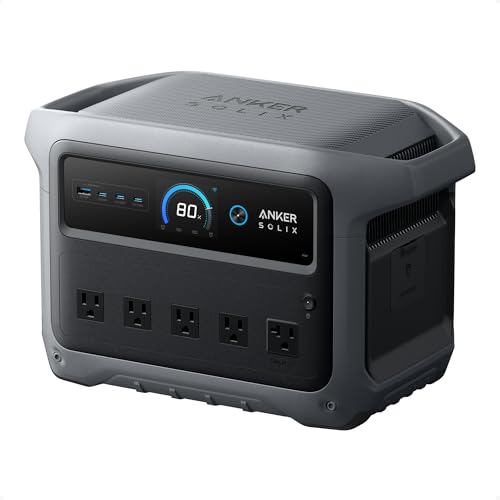
Anker SOLIX C1000 Gen 2 Portable
Best for: Basecamp video crews and mobile studios
Pros
- 2000W continuous output capacity
- 49-minute HyperFlash AC wall recharging
- Long-lasting 4000-cycle LiFePO4 chemistry
Cons
- Heaviest model in the lineup
The Anker SOLIX C1000 Gen 2 Portable power station delivers a 1,024Wh capacity paired with a 2,000W continuous output inverter capable of 3,000W peak surges. Utilizing InfiniPower LiFePO4 battery chemistry, the unit retains at least 80 percent of its original capacity after 4,000 full recharge cycles. Recharging speed is led by HyperFlash technology, which enables a full wall replenishment at 1,600W in 49 minutes through app configuration. Off-grid input supports up to 600W of solar charging (60V max) to achieve a full recharge in 1.8 hours, while an internal transfer switch provides a 10-millisecond uninterruptible power supply (UPS) switchover.
Field production crews running mobile basecamps, video village monitors, and multi-bay drone battery hubs will find this generator well suited for intensive field work. As discussed in our overview of anker large power bank hardware, heavy-duty stations ensure continuous runtime for studio lighting and DIT stations. The anker solix c1000 gen 2 provides massive power output across 10 total ports, though its larger physical footprint and heavier mass make it less practical for solo operators who need to hike gear into remote shooting locations.
05
Anker SOLIX C200 DC Portable Power
Best for: Drone operators requiring pure USB-C power
Pros
- Dual high-output USB-C ports up to 140W
- Compact 192Wh DC power station format
- 100W solar charging support
Cons
- No AC wall outlets included
The Anker SOLIX C200 DC Portable Power station offers a 192Wh capacity (listed as 60,000mAh in specifications) focused strictly on direct-current power distribution. The unit supplies 200W of total output through five charging ports, including a primary 140W two-way USB-C Power Delivery 3.1 port, a 100W USB-C port, a 15W USB-C port, and dual 12W USB-A ports. Recharge performance is rated at 80 percent in 1.3 hours via the 140W USB-C connection, or approximately 1.7 hours to full capacity. Long-term reliability is maintained by 3,000-cycle LFP cells backed by a 3-year warranty.
This model is built specifically for creators who power their entire mobile setup via USB-C, such as mirrorless cameras, audio gear, and editing laptops, eliminating the energy loss and bulk of an alternating current inverter. When evaluating portable energy options against systems like a jackery expansion battery pack, the DC-native approach of this station saves significant physical space. The anker solix c200 dc is 39 percent smaller than comparable stations, making it an excellent choice for solo backpackers, though it yields to the C300 if your production kit requires three-prong AC wall plugs.
06
Anker SOLIX C300 Portable Power Station
Best for: Outdoor cinematographers needing portable AC outlets
Pros
- Three AC outlets with 600W surge
- Dual 140W USB-C PD ports
- Quiet 25dB operation profile
Cons
- Carry strap sold separately
The Anker SOLIX C300 Portable Power Station provides a 288Wh capacity along with a 300W pure sine wave inverter capable of handling 600W surge loads. Output connections include three AC outlets delivering 300W combined, one 120W car auxiliary socket, two bi-directional 140W USB-C ports, one 15W USB-C port, and a 12W USB-A port. Wall charging brings the battery to 80 percent in 50 minutes, while external solar input supports up to 100W via compatible panels. The unit uses LiFePO4 cells rated for 3,000 cycles, runs at a quiet 25dB noise profile from 3.3 feet away, and includes a 5-year warranty.
Solo cinematographers and documentary filmmakers who need to run standard camera battery chargers, broadcast video transmitters, or low-wattage location lights will find the anker solix c300 highly capable. For lighter field applications, reviewing our anker 21000 portable charger article shows where handheld options fit into the mix. The C300 bridges the gap between pocket battery banks and heavy power stations, offering practical AC output in a compact package before workloads scale up to the high-capacity threshold of the C1000 Gen 2.
Matching a Model to Your Setup
- Solo run-and-gun wedding cinematographers: The Anker Power Bank delivers 87W of shared power and an integrated USB-C cable to quickly boost mirrorless camera bodies and laptops between shoot locations.
- Mobile smartphone vloggers: The Anker MagGo Power Bank provides wireless 15W Qi2 charging with a slim magnetic form factor that mounts directly to iPhone video rigs without cable clutter.
- Location DITs and mobile editors: The Anker Prime Power Bank supplies 220W total output, app power monitoring, and a desktop dock capable of running editing laptops and secondary field displays simultaneously.
- Multi-camera video village and basecamp crews: The Anker SOLIX C1000 Gen 2 Portable provides 1,024Wh of LiFePO4 capacity and 2,000W AC output to sustain lights, heavy workstation computers, and drone hubs.
- Backpacking drone operators and time-lapse shooters: The Anker SOLIX C200 DC Portable Power delivers 192Wh of DC-only energy across high-speed 140W USB-C ports without the bulk of an AC inverter.
- Outdoor documentary teams needing field AC plugs: The Anker SOLIX C300 Portable Power Station balances 288Wh of capacity with three AC outlets and whisper-quiet 25dB operation for audio-sensitive environments.
Before You Buy
When planning your field power strategy, pay close attention to the accessories included in each product package. The listings for both the SOLIX C200 DC and SOLIX C300 explicitly state that carrying shoulder straps are sold separately, and neither unit includes solar panels in the box. Furthermore, the C200 DC requires a separate 18W or higher USB-C wall charger to replenish from a standard wall outlet, as an AC adapter is not provided. Always review the included cable inventory to ensure you have compatible high-wattage charging blocks available before taking these power stations into remote environments.
Operating limitations and device compatibility also vary significantly across this hardware lineup. The MagGo power bank is engineered specifically for magnetic iPhones, and the listing explicitly notes that it is not recommended for Android handsets due to potential alignment issues and slower charging speeds. In addition, solar recharging on the C200 DC and C300 stations does not support 5V/3A panels or larger panels such as the PS200 or PS400 models. Always confirm that your specific field gear falls within the voltage and connector guidelines specified by the manufacturer.
FAQ
Which Anker high capacity battery pack can be taken on commercial flights?
The Anker Power Bank (20,000mAh) and the Anker Prime Power Bank (20,100mAh) fall under the standard 100Wh airline limit established for lithium-ion consumer electronics, making them approved for carry-on luggage. The MagGo 10,000mAh battery is also fully flight-compliant. Larger power stations, such as the SOLIX C200 DC (192Wh), C300 (288Wh), and C1000 Gen 2 (1,024Wh), exceed passenger airline carry-on limits and cannot be brought aboard standard commercial flights.
Can the Anker SOLIX C200 DC power standard household camera chargers?
The SOLIX C200 DC features only direct-current ports, consisting of three USB-C ports and two USB-A outlets. It does not contain an internal inverter or three-prong AC wall receptacles. If your camera battery chargers require a standard two-prong or three-prong AC wall plug, you will need to step up to the SOLIX C300 or C1000 Gen 2, both of which provide dedicated pure sine wave AC outlets.
How fast can the Anker Prime Power Bank be recharged between production shoots?
According to the product specifications, the Anker Prime Power Bank can replenish to 50 percent capacity in 27 minutes when connected to a 100W input source via its USB-C port or through its bundled 150W charging base. A full recharge cycle requires approximately 1.5 hours, allowing video crews to quickly restore power reserves during lunch breaks or short location moves.
What is the advantage of LiFePO4 battery chemistry in the SOLIX power stations?
The SOLIX series uses Lithium Iron Phosphate (LiFePO4 / LFP) battery cells, which offer significantly longer operational life compared to traditional lithium-polymer cells. The SOLIX C200 DC and C300 are rated for 3,000 charge cycles, while the C1000 Gen 2 is rated for 4,000 cycles before battery capacity drops to 80 percent. This longevity ensures multiple years of daily field use under demanding production conditions.
Does the Anker MagGo Power Bank charge non-Apple devices wirelessly?
The listing states that the MagGo Power Bank is specially designed for the iPhone 12 through 16 series with Qi2 magnetic alignment. The manufacturer explicitly does not recommend using it with Android phones, because physical differences in fit and magnetic alignment may result in compromised placement or significantly reduced charging speeds.


